Discover How Cultures Around the World Celebrate Love
Browse by Region
Explore wedding traditions from 244 countries and territories
Africa 57 countries
Asia 49 countries
Caribbean & Central America 37 countries
Europe 54 countries
North America 5 countries
Oceania & Pacific 27 countries
South America 15 countries
Explore by Map
Tap any country to explore its traditions
What comes after
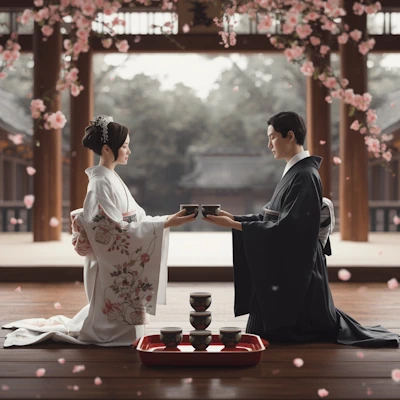
Some cultures let the couple leave quietly. Most do not.
In France, there is charivari. The guests gather outside the couple's window on the wedding night and make noise, pots and pans mostly, until the newlyweds come to the door with champagne. The ritual is old. The message is plain: you are not alone in this. You do not get to be alone in this. Your marriage belongs to your people too.
In Italy, la scampanata serves the same purpose. Friends arrive at midnight, banging whatever is at hand, and do not stop until they are fed.
In parts of India, what comes after is quieter but no less deliberate. The bride returns to her parents' home for a period before the couple establishes their own household. The separation is built into the structure. Her mother has spent weeks feeding guests and organizing ceremonies and holding herself together in a sari she ironed three times. Now the house is quiet. Her daughter's room is empty. For the bride's mother, it is one last pause before the world rearranges itself permanently. She will sit in that room. She does not need a reason. The reunion, when it comes, is the real beginning.
Japanese couples mark a year of firsts. First New Year together. First shrine visit. First ancestor festival. Each one witnessed, each one recorded, each one stitching the marriage deeper into the community's memory.
The wedding ends in an evening. The marriage takes its shape over years, in the small customs a couple keeps and the ones they quietly let go. These pages show you how communities around the world hold onto newlyweds and refuse to let the celebration end with the last dance.
The Animals Know Something
A white horse carries a Kenyan bride through her village, and every person who sees her understands: she is leaving one life and entering another. The horse does not know this. The horse just walks. But the procession it creates says what no speech can.
In Sri Lanka, a coconut is cracked before the couple to bless the union, and sometimes it is an elephant that leads the groom's procession to the ceremony, decorated in silk, moving slowly enough for the whole street to witness. In Romania, doves are released after the vows, two birds climbing into open sky, because a symbol of faithfulness works best when it flies away and you have to trust it will return. In parts of the Yemeni highlands, camels carry the bride's dowry across difficult terrain, the animals bearing the weight of a family's investment in a daughter's future.
Butterflies in Cambodia. Horses in Argentina. Every culture that puts an animal into a wedding is saying the same thing: this moment is bigger than the two of us. We need a creature that does not understand language to carry the part of it that language cannot hold.
Sacred Words and Vows Across Faiths
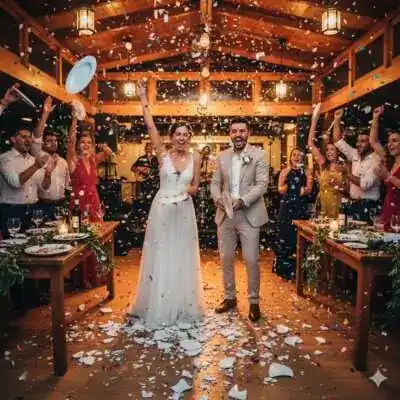
Every faith solved the same problem: how to make a private promise binding. The solutions are strikingly different.
In an Islamic nikah, the contract is the ceremony. The bride sets her mahr, the amount the groom must pay, and her consent must be spoken aloud, witnessed, and recorded. Without her "qubool hai," repeated three times, no marriage exists. The words are specific, financial, and legally enforceable. Romance is beside the point. The contract protects her.
A Sikh Anand Karaj circles the Guru Granth Sahib four times, each circuit accompanied by a hymn that describes the soul's journey toward God. The couple does not face each other. They face the scripture. What does it feel like to walk those circuits with the person you love, not looking at them, facing something larger than either of you? Every Sikh couple who has walked that path knows. The vows are not between two people. They are between two people and the divine, with the congregation as witness.
In Orthodox Christian ceremonies, the couple is crowned, physically, with stefana linked by ribbon. The crowns signify martyrdom: the willingness to sacrifice for each other. The priest leads the couple in a circular walk three times around the altar, the first steps of their shared journey. In Thailand, a Buddhist blessing involves monks chanting at dawn, sacred thread wound between the couple's joined hands, and lustral water poured over their fingers by every elder in the room. The ceremony is quiet. The water is warm.
The People Who Make It Real
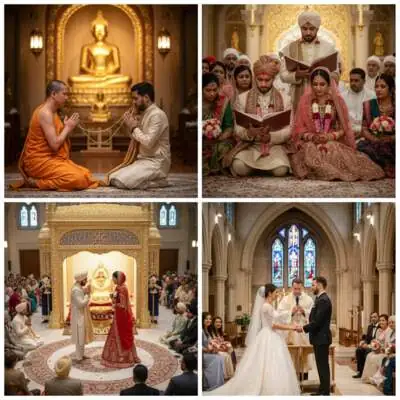
You cannot marry yourself. That is the one rule no civilization has ever broken.
In Latvia, married couples called vedeji serve as official witnesses, spiritual guides, and lifelong mentors. They sign the legal papers, guard the bride from symbolic "stealing," guide the couple through the Three Gates ceremony and the midnight Micosana, and accept a mentorship that does not expire when the reception ends. Choosing your vedeji is choosing the married couple whose relationship you want yours to resemble.
In Islamic tradition, the nikah contract requires at least two adult Muslim witnesses, and their presence is not ceremonial. Without them, the marriage is void. The wali, the bride's representative, ensures her interests are protected. Their signatures carry the weight of law.
At a Liberian wedding, the community witnesses the sacred kola nut untying, where the bride unties nuts bound with thin threads while the groom's family showers her with money. Patience, dedication, care: the threads test all three while the village watches. In Burundi, elders from both families must formally witness and approve the union before any ceremony can proceed, their presence a living seal on the promises being made.
Witnesses exist because love between two people is necessary but not sufficient. Marriage requires an audience willing to say: we saw this happen, and we will remember it.
Three Generations in the Kitchen
The feast does not appear on its own. Before anyone sits down, someone has been cooking since dawn. In most of the world, that someone is not a caterer. It is a grandmother, two aunts, a neighbor who arrived without being asked, and a teenager who has been put in charge of stirring something she does not yet understand.
At a Nigerian wedding, the jollof rice alone requires an outdoor fire, a pot the size of a bathtub, and three women who each believe their seasoning is correct. At a Mexican celebration in a small town, the mole has been simmering for two days, its thirty ingredients ground and folded by women whose hands know the recipe the way a pianist knows a score. No one measures. Everyone tastes.
In Indian kitchens, the preparation can span a week. Sweets are shaped by hand, the laddoos rolled between palms, the barfi cut into diamonds with a knife that has been used for every wedding in the family. Greek mothers bake kourabiedes by the hundred, each one dusted in powdered sugar that clouds the kitchen like weather.
The cooking is not labor. It is the first act of the celebration. The kitchen holds stories, arguments about garlic, someone's daughter learning to fold pastry for the first time. Italian families understand this instinctively. The meal is not what you serve. It is what you made together before anyone arrived.
The Power of the Bride
She sat very still while her mother drew henna across both palms and down each finger, the lines thin and certain. Neither of them spoke. They did not need to. The mehndi was doing what language could not do quickly enough: marking the passage, making the change visible on the body before the ceremony made it official.
Across dozens of cultures, separated by oceans and centuries, the same intuition persists: the bride carries a power that ordinary days do not hold. Chinese brides were shielded with red umbrellas during the procession, red being the color that repels malevolent spirits. Moroccan brides are secluded before the ceremony, kept from the gaze of envious spirits drawn to joy.
Korean brides historically had their faces painted white with red dots on each cheek, a pattern believed to confuse demons. The Western veil fits this pattern exactly. Whatever sentimental meaning we assign it now, its origin was concealment: hide the bride's face so that malevolent forces cannot find her.
But notice the double edge. Irish tradition holds that a bride's feet must not touch the ground while dancing, lest the fairies claim her. Which rather suggests the fairies consider her worth claiming. Every culture sensed that a woman remaking her life carries a force that must be honored, not merely protected. Every culture built rituals to say so.
Who Pays for the Wedding
Follow the money and you find the power. In the United States, the old rule said the bride's family pays. That rule is breaking down. Today, 43% of American couples fund their own weddings, and the average bill lands near $30,000. The question of who writes the check has shifted from tradition to negotiation, from obligation to choice. But in much of the world, the old economics still hold, and they reveal something the invitation never says.
At a Nigerian owambe, the guests are not spectators. They are the economy. Money spraying, the practice of pressing cash onto the dancing couple, turns the reception floor into a public ledger. Guests compete to spray the most. The total can exceed the cost of the event itself. The party funds itself and then some. This is not generosity performed for show. It is a communal investment system older than any bank, and it works.
In China, red envelopes arrive at the banquet table stuffed with cash in auspicious amounts: 888, 1,888, 8,888 yuan. The groom's family has already spent tens of thousands on Guo Da Li betrothal gifts. In Saudi Arabia, the mahr alone can reach 500,000 SAR, and wedding receptions run from 100,000 to 5,000,000 SAR, the obligation carrying the weight of social standing. Every culture answers the same question differently: who pays, and what does that payment purchase?
Luck, Omens, and the Things We Do Just in Case
Even the most rational people get a little superstitious on their wedding day. Something in us insists that a union this important deserves protection, whether from fate, spirits, or just bad weather.
The American and British "something old, something new, something borrowed, something blue" comes from a Victorian rhyme. Most brides skip the sixpence that ends it. But the first four persist because the logic is sound even if the magic is not: honor the past, welcome the future, borrow luck, wear fidelity.
Italian brides carry a small piece of iron to ward off the evil eye. Guests receive confetti, sugar-coated almonds, always in odd numbers because odd numbers are indivisible, like the couple should be.
Greek brides write the names of single friends on the soles of their shoes before the ceremony. The names worn away by the end of the day belong to whoever marries next. Participatory fortune-telling that ensures the bride dances hard.
Indian weddings are timed to the stars. The muhurat, the auspicious moment, is calculated by a priest using the couple's birth charts. The ceremony starts at the exact prescribed minute. The cosmos has weighed in and does not appreciate improvisation.
Nobody believes writing a name on your shoe will get anyone married. But you do it anyway, because on a day this important, care comes in every form available. And if your friend does get married next year, you will take full credit.