Greek Wedding Traditions Hellenic Wedding Guide 2025
What Are Greek Wedding Traditions?
Greek wedding traditions are centuries-old Orthodox Christian ceremonies and cultural customs that create multi-day celebrations typically involving 150-500 guests across mainland Greece and the islands. These traditions encompass pre-wedding rituals like the bed-making ceremony (To Krevati), the Orthodox church ceremony featuring stefanaSTEH-fah-nah crowns and the Dance of Isaiah, traditional circle dances including the Kalamatianos, symbolic foods like koufeta (sugar-coated almonds), and regional variations from Crete to Macedonia, creating celebrations that typically last 2-3 days and cost between EUR15,000-EUR50,000 ($16,000-$54,000 USD).
Complete Greek Wedding Process Overview
- 12-18 months before: Engagement ceremony (Aravones) with blessed rings
- 3-6 months before: Dowry preparation and family negotiations
- 1 week before: Pre-wedding celebrations (Glenti) begin
- 2-3 days before: Bed-making ceremony (To Krevati)
- Wedding day: Orthodox ceremony (2-3 hours) followed by reception (6-12 hours)
- Day after: Traditional Sunday family visit
- Total participants: 150-500 guests typical, up to 1,000 in villages
- Average cost: EUR15,000-EUR50,000 ($16,000-$54,000 USD)
Pre-Wedding Traditions and Ceremonies
Proxenia (Traditional Matchmaking)
Proxenia is the traditional Greek matchmaking system that historically connected families of similar social standing through professional matchmakers (proxa) or trusted family friends, dating back to 5th century BCE Athens. This centuries-old practice involved formal negotiations between families considering compatibility in social status, family reputation, and economic prospects, typically taking 3-6 months of formal discussions.
Historical matchmaking process:
- Professional matchmaker presents eligible candidates to families
- Background checks on family reputation and financial status
- Formal meetings arranged between families (3-5 visits typical)
- Dowry negotiations begin if match approved
- Blessing sought from local priest
Current practice: While formal matchmaking has largely disappeared except in remote villages of Epirus and mountain Crete, many Greek couples still seek parental approval before engagement, reflecting the continued importance of family involvement in marriage decisions. Modern adaptations include informal family introductions at social gatherings and community events, particularly during religious festivals.
Engagement Ceremony (Aravones)
Aravones is the formal Greek Orthodox engagement ceremony that involves a priest blessing gold rings exchanged three times by the koumbaros (wedding sponsor), symbolizing the Holy Trinity and lasting commitment. This ritual, evolved from Byzantine practices dating to the 8th century CE, typically involves 20-50 close family members and costs EUR500-EUR2,000 ($540-$2,160 USD).
Traditional engagement procedure:
- Priest blesses rings - Plain gold bands placed on ceremonial tray
- Koumbaros exchanges rings - Three times between couple’s right hands
- Couple exchanges rings - Worn on right hand until wedding
- Sweet treats shared - Traditional pastries like baklavabah-klah-VAH and kourabiedes
- Family toasts - With local wine or ouzo
Regional variations:
- Crete: Mantinades (improvised couplets) performed, adding 30-45 minutes
- Macedonia: Handwoven gifts exchanged between families (EUR200-EUR500 value)
- Cycladic islands: Community-wide celebration with 100+ attendees
- Mountain villages: Musical announcements using traditional instruments
Modern engagement practice: Formal engagement ceremonies remain popular among Greek couples, with the average engagement period lasting 12-18 months. Urban engagement parties typically cost EUR1,000-EUR5,000 ($1,080-$5,400 USD).
Bed-Making Ceremony (To Krevati)
To Krevati is the traditional bed-making ceremony that takes place 2-3 days before the wedding where female relatives and friends prepare the marital bed with new linens, throwing money, rice, rose petals, and koufeta while rolling young children on the bed to bring fertility and prosperity. This pre-wedding tradition, rooted in ancient Greek fertility rituals, typically involves 15-30 women and lasts 1-2 hours.
Ceremonial components:
- New bedding: Dowry linens worth EUR500-EUR2,000 ($540-$2,160 USD)
- Money throwing: EUR50-EUR500 ($54-$540 USD) in small bills
- Children rolling: 3-5 young children under age 7
- Symbolic items: Rice (abundance), rose petals (love), koufeta (sweetness)
- Traditional songs: Regional melodies lasting 20-30 minutes
Regional bed-making variations:
- Cyclades: Embroidered linens with specific island patterns (6-12 months to create)
- Northern Greece: Special blessing songs by eldest woman present
- Crete: Elaborate performances with lyra music (adds 45 minutes)
- Peloponnese: Specific herbs placed under mattress for protection
Current practice: Many Greek couples incorporate some version of To Krevati, with urban celebrations often simplified to 30-minute ceremonies. Modern adaptations include photographing the ceremony for social media and combining it with bridal shower activities.
Pre-Wedding Feast (Glenti)
Glenti is the series of pre-wedding celebrations that traditionally begin 3-7 days before the wedding, featuring progressive feasting between family homes with live music, traditional dancing, and 50-200 participants per gathering. These celebrations, costing EUR2,000-EUR10,000 ($2,160-$10,800 USD) total, serve to unite both families and the broader community before the wedding day.
Traditional Glenti structure:
- Day 1: Groom’s family hosts (50-100 guests)
- Day 2: Bride’s family hosts (50-100 guests)
- Day 3: Combined families at neutral venue (100-200 guests)
- Musicians: 3-5 piece traditional ensemble (EUR500-EUR1,500 per night)
- Food: Whole roasted lamb, local specialties (EUR20-EUR40 per person)
Modern Glenti adaptations: Urban couples often condense to single pre-wedding party (EUR3,000-EUR8,000), while rural communities maintain multi-day structure with 500+ total participants across all events.
Dowry and Trousseau (Prika)
Prika is the traditional Greek dowry system that historically included handmade textiles, household items, property, and gold jewelry prepared over many years, displayed publicly before the wedding to demonstrate family status. Though legally abolished in 1983, the concept persists with many Greek parents contributing EUR10,000-EUR100,000 ($10,800-$108,000 USD) toward their children’s new household.
Traditional dowry contents:
- Handmade textiles: 50-200 items including embroidered linens (10-15 years preparation)
- Furniture: Complete household furnishing (EUR5,000-EUR20,000 value)
- Property: Land or apartment in traditional arrangements
- Gold jewelry: 10-30 pieces including coins (EUR2,000-EUR15,000 value)
- Household items: Complete kitchen and dining sets
Dowry display tradition:
- Viewing period: 2-3 days before wedding
- Visitors: 100-300 community members
- Documentation: Written inventory of all items
- Social significance: Family status indicator
Regional dowry variations:
- Dodecanese: Carved wooden chests (EUR1,000-EUR3,000 each)
- Mountain communities: Region-specific woven patterns
- Crete: Specialized embroidery requiring 500+ hours work
- Urban centers: Modern appliances replace traditional crafts
Current practice: Modern “dowry” typically involves parents helping with apartment down payment (EUR20,000-EUR50,000 average) or furnishing newlyweds’ home (EUR10,000-EUR30,000).
Wedding Ceremony Traditions
Orthodox Wedding Ceremony (Gamou Mysterion)
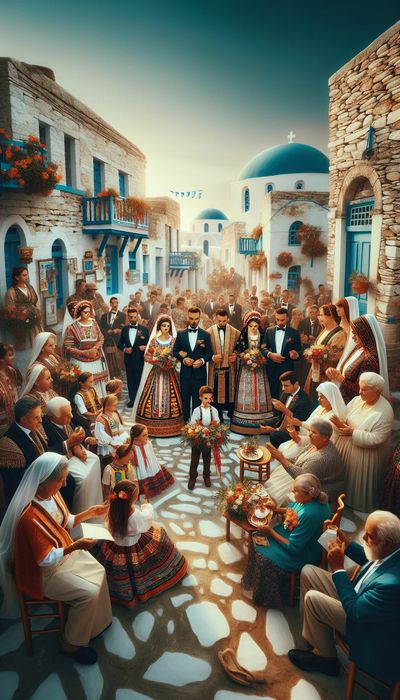
Gamou Mysterion is the Greek Orthodox wedding sacrament that combines the Betrothal Service (ring exchange) and Wedding Service (crowning ceremony) into a 60-90 minute ritual featuring stefanaSTEH-fah-nah crowns, shared wine cup, and the Dance of Isaiah around the altar. This ceremony, codified in the 8th century Byzantine liturgy, remains virtually unchanged and is practiced by the vast majority of Greek couples choosing religious ceremonies today.
Complete ceremony structure:
- Betrothal Service (15-20 minutes): - Blessing of rings by priest - Triple ring exchange by koumbaros - Prayers for couple’s commitment - Placement on right hands
- Wedding Service (45-60 minutes): - Lighting of candles (lambadeslahm-BAH-thes) - Joining of right hands - Crowning with stefana three times - Gospel and Epistle readings - Common cup of wine shared three times - Dance of Isaiah (circular procession three times) - Removal of crowns with blessing
Symbolic significance of ritual elements:
- Number three: Holy Trinity representation (every action repeated thrice)
- Right hands joined: Strength and unity in marriage
- Stefana crowns: Glory and honor as rulers of new household
- Circular procession: Eternal nature of marriage bond
- Shared cup: Common life and shared destiny
Church ceremony costs: EUR300-EUR1,000 ($324-$1,080 USD) for church fee, EUR200-EUR500 for ceremonial items, EUR500-EUR2,000 for floral decorations.
The Role of the Koumbaros or Koumbara
The Koumbaros (male) or Koumbara (female) is the wedding sponsor who performs essential ceremonial duties including exchanging the rings and crowns three times, holding the ribbon connecting the stefana, and following the couple during the Dance of Isaiah. This spiritual relationship, dating to early Christian mentorship practices, creates lifelong bonds considered nearly equal to blood relationships.
Ceremonial responsibilities:
- Ring exchange: Switches rings between couple three times
- Crown placement: Places and exchanges stefana three times
- Ribbon holding: Maintains connection between crowns
- Processional following: Walks behind couple during Dance of Isaiah
- Financial support: Typically contributes EUR1,000-EUR5,000 ($1,080-$5,400 USD)
Selection traditions:
- Family priority: Often the groom’s brother or close cousin
- Baptismal connection: May be the person who baptized bride/groom
- Inherited role: Some families follow tradition of specific koumbaros lineage
- Close friends: Modern couples increasingly choose best friends
Ongoing responsibilities: The koumbaros traditionally baptizes the couple’s first child, provides marital guidance, and maintains special relationship with family. Being selected as koumbaros is considered one of the highest honors in Greek culture.
Wedding Crowns (Stefana)
Stefana are the ceremonial wedding crowns connected by ribbon and exchanged three times during the Greek Orthodox ceremony, symbolizing the couple’s glory, honor, and unity as they establish their household kingdom. These crowns, evolving from ancient Greek laurel wreaths through Byzantine metal designs, range from simple flower arrangements (EUR50-EUR150) to elaborate gold-plated versions (EUR500-EUR2,000).
Traditional stefana materials:
- Fresh flowers: Orange blossoms, myrtle (EUR50-EUR150)
- Silver-plated metal: Most common choice (EUR150-EUR400)
- Gold-plated designs: For wealthy families (EUR500-EUR2,000)
- Porcelain flowers: Early 20th century innovation (EUR100-EUR300)
- Family heirlooms: Passed through generations (priceless)
Symbolic elements:
- Circular shape: Eternity and unending marriage bond
- Connected ribbon: Unity of the couple
- Triple exchange: Holy Trinity blessing
- White or gold color: Purity and divine light
- Post-wedding display: Stefanothiki case in home’s eastern corner
Regional stefana variations:
- Crete: Incorporate local herbs and wildflowers
- Islands: May include small shells or maritime elements
- Northern Greece: Often more ornate with Byzantine influences
- Urban areas: Tend toward minimalist modern designs
Current practice: The vast majority of Greek Orthodox couples use stefana in ceremonies, with many displaying them prominently in their homes afterward. Modern couples often personalize stefana with family symbols while maintaining traditional circular form.
Reception and Celebration Traditions
Traditional Wedding Feast
The Greek wedding feast is a multi-course banquet lasting 4-8 hours featuring regional specialties, whole roasted lamb or goat, elaborate sweet tables, and late-night sustaining dishes, typically serving 150-500 guests at EUR40-EUR100 ($43-$108 USD) per person. This tradition of abundant hospitality (philoxenia) dates to ancient Greece and remains central to modern celebrations.
Traditional feast progression:
- Mezedes (1-2 hours): 15-30 appetizer varieties - Dolmades, tzatziki, taramosalata (EUR5-EUR10 per person) - Spanakopitaspah-nah-KOH-pee-tah, tyropita, keftedes - Regional seafood in coastal areas - Local cheese varieties
- Main courses (2-3 hours): Regional specialties - Whole roasted lamb/goat (EUR300-EUR800 per animal) - Fresh fish for island weddings (EUR25-EUR40 per kg) - Moussakamoo-SAH-kah, pastitsio for urban receptions - Multiple meat preparations with sides
- Sweet table (2-3 hours): 20-40 dessert varieties - Baklavabah-klah-VAH, galaktoboureko, kourabiedes - Regional specialties (EUR3-EUR8 per piece) - Multi-tiered wedding cake (EUR300-EUR1,500) - Fresh fruit displays
- Late-night offerings (after midnight): - Patsas soup for stamina (EUR5-EUR10 per bowl) - Additional meat dishes - Savory pies for energy
Regional feast specialties:
- Crete: Gamopilafo rice, antikristoahn-DEE-kree-stoh lamb, local cheeses (adds EUR10-EUR15 per person)
- Islands: Emphasis on fresh seafood, octopus, local vegetables
- Northern Greece: Heavier meat dishes with Balkan influences
- Peloponnese: Specific local wine pairings, olive oil prominence
Modern feast statistics: Average wedding meal costs EUR8,000-EUR25,000 total, includes 3-5 meat options, 25-40 total dishes, serves average 250 guests.
Money Dance (Kalamatiano)
The money dance is the tradition where guests pin money directly onto the couple’s clothing while dancing the Kalamatianokah-lah-mah-tee-AH-noh, helping fund their honeymoon and new household with contributions typically totaling EUR2,000-EUR10,000 ($2,160-$10,800 USD). This Byzantine-era custom combining community support with celebratory dancing remains widely practiced at Greek weddings.
Traditional money dance procedure:
- Koumbaros initiates: Pins first bill (usually EUR50-EUR100)
- Family members follow: Close relatives pin larger amounts (EUR50-EUR500)
- Guests form line: Each pins money and dances briefly with couple
- Music continues: Special Kalamatiano played throughout (20-45 minutes)
- Collection concludes: When all guests have participated
Regional money dance variations:
- Epirus: Slow, dignified dances for money collection
- Crete: Money collected in decorative basket or cloth
- Islands: Sometimes use coins for symbolic sound
- Macedonia: Specific vocal accompaniments during dance
Modern adaptations: Urban weddings may use decorative bags, shortened versions for time (15-20 minutes), or pre-arranged “performances” to avoid chaos. Average contemporary collections range EUR1,500-EUR5,000 in cities, EUR3,000-EUR15,000 in villages.
Traditional Greek Wedding Dances
Greek wedding dances are ceremonial circle dances led by the couple and joined by guests in order of relationship closeness, featuring the Kalamatiano (12-count), Syrtos (smooth-flowing), Tsamikos Zeibekikozay-BEH-kee-koho;s strength dance), and Zeibekiko (solo improvisation). These dances, with origins in ancient Minoan and Mycenaean periods, structure the reception’s 4-6 hour celebration period.
Essential wedding dances:
- Kalamatiano (performed 3-5 times): - 12-count circle dance - Smooth, flowing movements - All guests participate - 10-15 minutes per session
- Syrtos (early reception): - Quick, smooth steps - Led by bride and groom - Engages all generations - 5-10 minutes duration
- Tsamikos (groom’s showcase): - Athletic leaps and squats - Male relatives join - Demonstrates strength - 5-8 minutes typical
- Zeibekiko (emotional solo): - Groom’s personal expression - Guests show respect by not joining - 3-5 minutes duration - Often performed late evening
Regional dance variations:
Pentozalipen-toh-ZAH-lee>Crete: Pentozali, Maleviziotis (rapid 8-10 minute sets)Dance progression: Average reception includes 15-20 dance sets, 60-90 total minutes of traditional dancing, with high guest participation in circle dances.
Breaking of Plates (Spasimo Piaton)
Spasimo Piaton is the tradition of breaking plates during peak celebration moments to ward off evil spirits and demonstrate abundance, originally using ceramic dishes but now typically employing specially-made plaster plates for safety. This ancient practice, with archaeological evidence from 500 BCE wedding sites, has been modified since the 1970s but remains symbolically important at many Greek weddings.
Historical plate breaking significance:
- Noise creation: Scares malevolent spirits (ancient belief)
- Prosperity display: Shows wealth through destruction
- Emotional release: Cathartic expression of joy
- Permanence symbol: Irreversible like marriage bond
- Community participation: Collective celebration act
Modern safety adaptations:
- Plaster plates: Break safely, cost EUR0.50-EUR2 each
- Designated moments: Controlled breaking times
- Flower throwing: Common substitute in many venues
- “Opa!” shouting: Verbal substitute when breaking prohibited
- Limited quantities: 20-50 plates typical vs historical hundreds
Regional breaking variations:
- Tourist areas: More likely to maintain tradition
- Urban venues: Usually prohibit entirely
- Rural celebrations: May still use real plates
- Islands: Often substitute with flower petals
Current practice costs: Plaster plates EUR50-EUR200 per wedding, cleaning fees EUR100-EUR300 at venues allowing breaking, flower alternatives EUR100-EUR400.
Koufeta (Sugar-Coated Almonds)
Koufeta are sugar-coated almonds given in odd numbers (tybombonieresbohm-boh-nee-EH-resr 7) inside decorative bombonieres to symbolize the bittersweet nature of marriage and indivisible unity of the couple. This Byzantine tradition, documented since medieval times, remains nearly universal at Greek weddings with couples spending EUR2-EUR10 ($2.16-$10.80 USD) per guest on these favors.
Symbolic significance:
- Bitter almond core: Life’s hardships
- Sweet sugar coating: Joy and happiness in marriage
- White color: Purity and new beginnings
- Odd numbers: Indivisibility like marriage (5 = health, wealth, happiness, fertility, longevity)
- Hard shell: Endurance of marriage bond
Traditional presentation in bombonieres:
- Tulle bags: Most common, tied with ribbon (EUR2-EUR5 each)
- Decorative boxes: For formal weddings (EUR5-EUR15 each)
- Silver items: Include small charms or crosses (EUR8-EUR20 each)
- Personalized containers: Modern trend (EUR10-EUR30 each)
Distribution moments:
- Church exit: Traditional timing for distribution
- Reception tables: Pre-placed at each setting
- Receiving line: Handed personally by couple
- Dance floor: During specific traditional dances
Regional bomboniere variations:
- Cyclades: Include miniature maritime elements
- Macedonia: Feature specific embroidery patterns
- Crete: May add local herbs for protection
- Urban areas: Elaborate designs with crystals or metals
Current statistics: Average couple orders 10-20% extra bombonieres beyond guest count, spends EUR500-EUR3,000 total on favors, with most choosing traditional tulle presentations.
Regional Wedding Variations
Cretan Wedding Traditions
Cretan wedding traditions represent Greece’s most distinctive regional variations, featuring improvised mantinades poetry, Cretan lyra music with rapid Pentozalipen-toh-ZAH-lee dancing, multi-day village celebrations involving 500-1,000 participants, and specialized dishes like gamopilafo rice and antikristoahn-DEE-kree-stoh lamb. These mountain and coastal customs, maintained by Crete’s 630,000 residents, create celebrations costing EUR20,000-EUR60,000 ($21,600-$64,800 USD) over 3-5 days.
Distinctive Cretan elements:
- Mantinades: Improvised rhyming couplets performed throughout (50-100 created per wedding)
- Lyra music: 3-string instrument leading all celebrations (EUR1,000-EUR2,500 for musicians)
- Dance traditions: Pentozali, Maleviziotis at 140-180 beats per minute
- Kerasma hospitality: Pre-wedding visitorakiRAH-keelcomimezedesmeh-ZEH-thes raki and mezedes
- Village involvement: Much of the community participates in preparations
Cretan feast specialties:
- Gamopilafo: Wedding rice in lamb broth (serves 10-15 per pot)
- Antikristo: Lamb cooked facing fire (4-5 hours preparation)
- Staka: Clarified butter sauce (EUR20-EUR30 per kg)
- Kserotigana: Spiral honey pastries (200-500 pieces typical)
- Local raki: 50-100 liters consumed over celebration
Community preparation traditions:
- Meat hunting: Young men hunt 2-3 days before
- Communal cooking: 30-50 women prepare feast
- House preparation: Entire village helps decorate
- Music rehearsals: Local musicians practice specific wedding songs
Modern Cretan wedding practice: Many Cretan couples maintain full traditional celebrations, with average 400-600 guests attending and celebrations lasting 15-20 hours on the main day.
Macedonian Wedding Customs
Macedonian wedding traditions blend Greek Orthodox practices with Balkan influences, featzurlaZOOR-lah brass band zurla music, elaborate circle dances with complex footwork, distinctive wedding breads with fertility symbols, and multi-generational family participation. These northern customs, practiced by Macedonia’s 2.1 million residents, typically cost EUR15,000-EUR40,000 ($16,200-$43,200 USD).
Macedonian distinctive elements:
- Brass bands: 8-15 musicians (EUR2,000-EUR5,000 for reception)
- Zurla/Davul: Traditional wind and drum combination
- Complex dances: 20+ traditional patterns with intricate steps
- Wedding bread: Elaborate decorations taking 10-15 hours
- Gold coin traditions: Bride wears 20-50 coins (EUR2,000-EUR8,000 value)
Pre-wedding Macedonian customs:
- Bride preparation: 5-6 hours with female relatives
- Bread blessing: Special prayers over decorated loaves
- Dowry parade: Through village streets (in rural areas)
- Musical processions: Between family homes
Macedonian feast characteristics:
- Influences: Serbian and Bulgarian elements in cuisine
- Meat emphasis: 5-7 different preparations typical
- Pepper spreads: Ajvar and pindjur accompaniments
- Wine traditions: Local Tikves region wines featured
- Duration: 8-10 hour minimum celebration
Current practice: Macedonian couples commonly include brass bands, traditional breads remain central to weddings, with average guest count 200-350 in cities, 400-600 in villages.
Island Wedding Customs (Cyclades, Dodecanese, Ionian)
Greek island wedding customs reflect maritime heritage and historical influences, with Cycladic minimalist aesthetics, Dodecanese elaborate costumes worth EUR2,000-EUR10,000, and Ionian Venetian-influenced traditions creating unique celebrations for the 1.3 million island residents. Island weddings typically feature 100-300 guests and cost EUR18,000-EUR50,000 ($19,440-$54,000 USD).
Cycladic traditions (Mykonos, Santorini, Paros):
- White and blue themes: Reflecting architecture
- Sea blessings: Priest blesses couple facing water
- Maritime symbols: Anchors, shells in wedding breads
- Fishermen roles: Lead boat processions when applicable
- Violin-led music: Distinct from mainland clarinet traditions
Dodecanese variations (Rhodes, Karpathos, Kos):
- Wedding costumes: Handwoven, embroidered (500+ hours work)
- Multi-day structure: 5-7 days traditional celebration
- Dowry displays: Most elaborate in Greece
- Vocal traditions: Unique polyphonic singing styles
- Sweet preparations: Italian-influenced due to occupation
Ionian practices (Corfu, Kefalonia, Zakynthos):
- Kantades: Serenading traditions from Venice
- Western elements: Organ music in churches
- Ring ceremonies: Elaborate Venetian-style presentations
- Architecture: Celebrations in Venetian buildings
- Cuisine: Pasta dishes alongside Greek foods
Modern island wedding practice: Many island couples maintain full traditional dress, boat processions are used in coastal weddings, with average celebration lasting 12-15 hours.
Pontic Greek Wedding Customs
Pontic Greek weddings preserve Black Sea heritage through kemenche (3-string lyra) music, the athletic Serra dance, distinctive zipka costumes, and ceremonies incorporating dialect elements from their pre-1923 homeland. These traditions, maintained by 500,000 Pontic Greeks after the 1920s population exchange, create emotionally significant celebrations costing EUR12,000-EUR35,000 ($12,960-$37,800 USD).
Distinctive Pontic elements:
- Kemenche music: Haunting melodies unique to Black Sea region
- Serra dance: Military-style formation requiring training
- Zipka attire: Men’s pleated kilts (EUR500-EUR1,500 each)
- Dialect usage: Pontic Greek in songs and blessings
- Memorial aspects: Honoring ancestral homeland loss
Ceremonial variations:
- Chalice designs: Unique to Pontic tradition
- Dance of Isaiah: Distinctive Black Sea execution
- Additional blessings: Reflecting historical displacement
- Icon traditions: Specific Black Sea saint devotions
Pontic feast elements:
- Preserved recipes: From pre-1923 homeland
- Dairy emphasis: Specific cheese preparations
- Corn dishes: Reflecting Black Sea agriculture
- Tea service: Maintaining regional tradition
Cultural preservation: Most Pontic couples include kemenche music and incorporate dialect elements, with younger generations learning traditions specifically for weddings.
Modern Adaptations and Current Trends
Contemporary Greek Wedding Evolution
Modern Greek weddings thoughtfully blend tradition with contemporary preferences, incorporating sustainable practices, digital elements, and personalized cultural research while maintaining core Orthodox ceremonies and family-centered celebrations. Average modern weddings involve 200-300 guests, last 8-10 hours, and cost EUR20,000-EUR45,000 ($21,600-$48,600 USD).
Sustainability adaptations:
- Eco-friendly bombonieres: Biodegradable packaging growing in popularity
- Local sourcing: Many couples prioritize regional food suppliers
- Rice alternatives: Lavender, rose petals increasingly used
- Digital invitations: Reduces paper use
- Vintage elements: Family heirloom incorporation common
Technology integration:
- Live streaming: For diaspora family members abroad
- Digital documentation: Professional videography capturing traditions
- Wedding websites: Explaining customs for international guests
- Social media: Dedicated hashtags and sharing
- Virtual participation: Remote blessings from distant relatives
Personalization trends:
- Regional research: Couples studying specific family traditions
- Custom music: Mixing traditional with contemporary
- Flexible timing: Condensed ceremonies for modern schedules
- Dietary accommodations: Vegan/vegetarian options alongside traditional
- Language considerations: Bilingual ceremonies increasing in Athens
Destination Weddings with Authentic Elements
Greek destination weddings combine stunning locations with authentic local traditions, attracting thousands of international couples annually who spend EUR25,000-EUR80,000 ($27,000-$86,400 USD) incorporating genuine regional customs rather than generic “Greek” elements. Popular destinations include Santorini, Mykonos, Crete, and Rhodes.
Authentic incorporation strategies:
- Local musicians: Hiring regional specialists (EUR1,500-EUR4,000)
- Traditional venues: Historic churches, not just scenic spots
- Regional cuisine: Specific local dishes, not pan-Greek menus
- Community involvement: Including local residents (creates authentic atmosphere)
- Custom education: Pre-wedding cultural briefings for guests
Destination wedding adaptations:
- Condensed traditions: 2-day format instead of week-long
- Translation services: For non-Greek speaking guests (EUR500-EUR1,500)
- Simplified dances: Teaching basic steps before reception
- Climate considerations: Timing ceremonies for weather
- Legal navigation: Civil ceremony plus religious blessing
Economic impact: Destination weddings contribute significantly to the Greek economy, creating employment for thousands of workers, with average 80-120 guests per wedding spending EUR1,000-EUR2,500 each on travel.
Interfaith and International Adaptations
Interfaith Greek weddings creatively adapt Orthodox traditions for mixed-religion couples, with international marriages increasingly common, requiring thoughtful modifications that honor both cultures while maintaining meaningful symbolism. These adaptations typically add EUR2,000-EUR5,000 ($2,160-$5,400 USD) for additional coordination and translation.
Common adaptation strategies:
- Modified ceremonies: Orthodox blessings without full sacrament (approved by some priests)
- Symbolic stefana: Used in secular ceremonies as unity ritual
- Dual celebrations: Separate religious ceremonies plus unified reception
- Cultural education: Programs explaining traditions to all guests
- Inclusive music: Alternating between both cultural traditions
Interfaith accommodation examples:
- Jewish-Greek: Chuppah incorporating stefana elements
- Catholic-Orthodox: Joint ceremonies where permitted
- Islamic-Greek: Separate ceremonies, unified cultural reception
- Hindu-Greek: Blending garland and crown symbolism
- Secular adaptations: Civil ceremony with Greek cultural elements
Translation and communication:
- Multilingual programs: Average 3 languages (EUR200-EUR500)
- Ceremony translation: Real-time interpretation available
- Cultural liaisons: Helping non-Greek families participate
- Simplified explanations: For complex religious elements
Success in interfaith unions: Most interfaith couples report satisfaction with adaptations, and international guests appreciate cultural education elements, with trend toward more inclusive practices growing annually.
Post-Pandemic Wedding Trends
Recent Greek weddings show significant shifts toward smaller, more intimate celebrations with average guest counts dropping, while maintaining traditional elements and adding health-conscious modifications costing additional EUR1,000-EUR3,000 ($1,080-$3,240 USD) for safety measures.
Major trend shifts:
- Guest list reduction: Focus on immediate family and close friends
- Outdoor preferences: Many couples now choose outdoor venues
- Extended celebrations: Multi-day format allowing smaller gatherings
- Quality emphasis: Higher per-guest spending with fewer attendees
- Local focus: Many couples choose venues close to home
Health-conscious adaptations:
- Spaced seating: Traditional circle dances with distancing
- Individual servings: Plated meals replacing some buffets
- Outdoor ceremonies: When religiously permitted
- Sanitization stations: Designed to match wedding aesthetic
- Modified traditions: Koufeta in sealed individual packages
Economic adjustments:
- Flexible contracts: Most venues now offer change options
- Streaming packages: Professional services EUR500-EUR2,000
- Micro-wedding options: 50-100 guests growing in popularity
- Payment plans: Extended options for economic uncertainty
Lasting changes: Industry experts predict continued preference for outdoor venues, maintained streaming options for distant relatives, and sustained focus on meaningful guest lists over large gatherings.
Learn More About Related Wedding Traditions
Greek wedding customs share fascinating connections with other cultural traditions around the world. The Orthodox ceremony elements found in Greek weddings connect to a broader Eastern Christian heritage, while the emphasis on family and community celebrations resonates with Turkish and Cypriot traditions in the broader Mediterranean region.
For authoritative information about Greek cultural heritage and traditional customs, the Hellenic Ministry of Culture and Sports provides comprehensive resources on Greece’s intangible cultural heritage, including wedding traditions recognized for their historical significance.
Conclusion
Greek wedding traditions demonstrate remarkable resilience and adaptability, maintaining their essential character while evolving to meet contemporary needs. From the sacred stefana crowns to the joyful Kalamatiano, these customs create uniquely meaningful celebrations that honor both ancient heritage and modern love stories. Whether celebrated in a mountain village in Crete with 1,000 guests or at an intimate Santorini gathering with 50, Greek weddings continue to embody the values of family, faith, community, and generous hospitality that have defined Greek culture for millennia.
The endurance of these traditions, with koufeta remaining nearly universal, Orthodox ceremonies continuing as the most common choice, and traditional dances central to most celebrations, reveals their continued relevance in expressing cultural identity and creating memorable celebrations that connect generations through shared customs and timeless symbolism.
Frequently Asked Questions
How much does a traditional Greek wedding cost?
Traditional Greek weddings typically cost between €15,000-€50,000, depending on guest count (usually 150-500 people), location, and included traditions.
What is the stefana ceremony in Greek weddings?
The stefana ceremony involves placing connected crowns on the couple's heads, symbolizing their union and status as king and queen of their new household.
What is the role of the koumbaros in Greek weddings?
The koumbaros/koumbara is the wedding sponsor who performs crucial ceremony roles, including exchanging the stefana crowns and serving as spiritual mentor to the couple.
What are koufeta and why are they important?
Koufeta are sugar-coated almonds given to guests, symbolizing the bittersweet nature of marriage. They're always distributed in odd numbers, considered lucky in Greek culture.
What is the Kalamatiano dance?
The Kalamatiano is a traditional circle dance where guests pin money on the newlyweds' clothing while dancing, symbolizing prosperity and community support.
How long do Greek wedding celebrations last?
Greek wedding celebrations typically span 2-3 days, including pre-wedding events, the ceremony, and extended reception festivities.
What is the To Krevati ceremony?
To Krevati is the traditional bed-making ceremony where family and friends prepare the couple's marital bed, often throwing money and children on it for fertility.
Is the dowry system still practiced in Greek weddings?
While less common today, the Prika (dowry) tradition still influences some families, though it's usually expressed through helping the couple establish their home.
What should guests wear to a Greek wedding?
Guests should dress formally, with women avoiding white (reserved for the bride). For church ceremonies, modest attire with covered shoulders is appropriate.
Are Greek weddings always religious ceremonies?
Traditionally, Greek weddings are Orthodox Christian ceremonies, though modern couples may opt for civil ceremonies or blend religious elements with secular celebrations.