Hawaiian Wedding Traditions: Where Aloha Spirit Meets Sacred Island Ceremony
Timeline Overview: Planning a Hawaiian Wedding
- 12 months before: Select venue and kahu (officiant), begin lei and flower sourcing
- 6 months before: Confirm ceremony elements, commission haku lei and attire
- 3 months before: Finalize vows (Hawaiian language options), book hula performers and musicians
- 1 month before: Rehearse ceremony protocols, prepare ti leaf bundles, confirm luau menu
- 1 week before: Final blessing of ceremony site, lei preparation begins
- Wedding day: Conch shell call, processional, Hawaiian blessing, vows, lei exchange, hula, luau feast
- Post-wedding: Couple’s blessing at sunrise, mahalo gathering for family
Pre-Wedding Traditions: Blessings, Preparations, and Spiritual Cleansing
Selecting a Kahu (Officiant)
Kahu (KAH-hoo) is the Hawaiian term for a minister, priest, or spiritual officiant who conducts wedding ceremonies, serving as the spiritual guardian of the union and the bridge between the couple and the divine. In traditional Hawaiian culture, the kahu is far more than a licensed officiant reading scripted lines – the kahu is a keeper of spiritual knowledge, a practitioner of prayer and chant, and the person responsible for ensuring that the ceremony carries genuine mana (spiritual power). Selecting the right kahu is considered the single most important planning decision in a Hawaiian wedding.
Traditional kahu undergo years of apprenticeship learning oli (chants), pule (prayers), and the protocols of ceremony. A culturally knowledgeable kahu costs $500-$2,000 USD depending on ceremony complexity, travel requirements, and whether they provide additional services like pre-wedding counseling or blessing ceremonies. Many kahu are also hula masters, genealogy keepers, or practitioners of la’au lapa’au (Hawaiian herbal medicine), bringing a depth of cultural knowledge that transforms a ceremony from a legal formality into a spiritual event.
When choosing a kahu, couples should ask about their training lineage, their familiarity with specific Hawaiian ceremonial elements, and whether they conduct ceremonies in the Hawaiian language. Some kahu specialize in particular ceremony types – ocean blessings, mountaintop ceremonies, or traditional heiau (temple) rites. The kahu-couple relationship typically begins 3-6 months before the wedding with initial consultations to understand the couple’s connection to Hawaiian culture, their families’ backgrounds, and which ceremonial elements hold the most meaning.
Ti Leaf Cleansing and Spiritual Preparation
Ti leaf cleansing (lau ki purification) is a pre-wedding spiritual ritual where the kahu uses the leaves of the ti plant (Cordyline fruticosa) to bless and purify the ceremony space, the couple, and sometimes the wedding party, removing negative energy and inviting positive spiritual forces. The ti plant holds profound significance in Hawaiian culture as a plant of protection, healing, and divine connection – Hawaiians believe ti leaves ward off evil spirits and attract good fortune, which is why ti plants are commonly found surrounding Hawaiian homes and sacred sites.
The cleansing ceremony typically takes 20-45 minutes, costs $200-$500 USD when performed as a separate pre-wedding event, and involves the kahu dipping ti leaf bundles in ocean water or fresh spring water while chanting prayers specific to marriage blessings. The kahu sweeps the ti leaves over the couple’s bodies from head to toe, over the ceremony altar, and around the perimeter of the wedding site. Some kahu incorporate Hawaiian salt (pa’akai) gathered from traditional salt ponds, sprinkling it at the four cardinal points to establish sacred boundaries.
In modern practice, the ti leaf cleansing is often integrated into the opening of the wedding ceremony itself rather than performed as a separate event, saving time while preserving spiritual significance. Rural Hawaiian communities, particularly on the Big Island and Molokai, maintain more elaborate multi-day purification practices including ocean bathing at dawn and fasting before the ceremony.
Ho’oponopono (Reconciliation Practice)
Ho’oponopono (HOH-oh-POH-noh-POH-noh) is a traditional Hawaiian practice of reconciliation and forgiveness that some couples incorporate into their pre-wedding preparation, involving guided discussions facilitated by an elder or kahu to resolve any lingering conflicts between the families before the union is formalized. The practice is rooted in the Hawaiian belief that unresolved emotional conflicts create spiritual blockages that can harm a new marriage.
In a wedding context, ho’oponopono sessions involve both families sitting together, often in a circle, while the facilitator guides conversations through four key phrases: “I’m sorry, please forgive me, thank you, I love you.” These sessions cost $300-$800 USD when conducted by a trained practitioner over 2-4 hours, and they address everything from minor family tensions to deeper generational wounds. The practice has gained international recognition as a conflict resolution method, but in Hawaiian weddings it maintains its original spiritual dimension – participants believe that forgiveness literally releases negative energy (hewa) and restores the flow of aloha between families.
Modern couples often incorporate a simplified ho’oponopono moment into their ceremony, where the kahu invites both families to silently release any grievances and offer blessings to the union. This practice connects Hawaiian wedding traditions to broader Polynesian values of communal harmony found in Samoan and Tongan cultures, though the Hawaiian version emphasizes individual spiritual responsibility rather than hierarchical family authority.
Wedding Day Ceremonies: From Conch Shell to Final Blessing
Blowing of the Pu (Conch Shell)
Pu (POO) is a large conch shell trumpet blown at the opening of a Hawaiian wedding ceremony, producing a deep, resonant tone that carries across the landscape and serves as a spiritual announcement that a sacred event is about to begin. The sound of the pu is believed to clear the air of negative energy, call the attention of ancestors and spiritual beings, and create a transition from the ordinary world into sacred ceremonial space. In ancient Hawaii, the pu was blown to announce the arrival of ali’i (royalty), the beginning of important gatherings, and to communicate across valleys – its use in weddings connects the couple’s union to this lineage of significant moments.
The pu is typically blown three times: once to honor the past and ancestors, once to honor the present moment and gathered guests, and once to honor the future the couple will build together. Some kahu blow the pu themselves, while others designate a family member or a trained pu blower, costing $100-$300 USD as a dedicated service. The shell itself ranges from $50-$500 USD depending on size and quality, with many couples purchasing one as a wedding keepsake.
The pu blast signals guests to stand and the wedding party to begin their processional. In beach ceremonies, the sound mingles with ocean waves, creating an acoustic experience that guests consistently describe as one of the most memorable moments of the entire wedding. Indoor ceremonies at venues like churches or hotels sometimes omit the pu due to acoustics, though many couples insist on including it regardless of venue, positioning the blower at the entrance or outside an open window.
The Processional and Ceremony Opening
Hawaiian wedding processionals differ from mainland American traditions through their emphasis on spiritual preparation over theatrical presentation, typically involving a slower, more meditative walk accompanied by Hawaiian music rather than classical orchestral pieces. The processional begins after the pu blast, with the kahu leading the groom to the ceremony site, followed by the wedding party, and concluding with the bride’s entrance.
Traditional processional music includes slack-key guitar (ki ho’alu), ukulele, and Hawaiian vocal chant. Professional Hawaiian musicians cost $300-$1,500 USD for ceremony music, with many couples hiring a trio of ukulele, guitar, and vocalist. The beloved song “Hawaiian Wedding Song” (Ke Kali Nei Au), composed by Charles E. King in the early 20th century and later popularized by Elvis Presley, remains the most requested processional piece, though many couples now choose traditional oli chants for a more culturally authentic entrance.
The kahu opens the ceremony with a pule (POO-leh), a Hawaiian prayer invoking the presence of ke Akua (God/the divine), the aumakua (ancestral guardians), and the elemental forces of nature – earth, water, wind, and fire. The pule may be delivered entirely in Hawaiian, entirely in English, or bilingually, depending on the couple’s preference and the guests’ language needs. A traditional pule lasts 3-5 minutes and sets the spiritual tone for everything that follows. Some kahu begin with an oli (chant) rather than a spoken prayer, using a melodic recitation style that predates Western contact and carries profound cultural weight.
Lei Exchange Ceremony
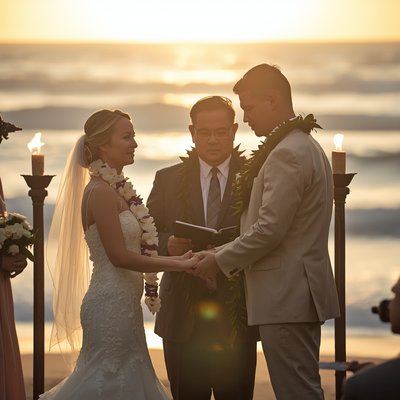
Lei exchange is the most iconic element of Hawaiian weddings, serving as the Hawaiian equivalent of ring exchange in mainland ceremonies, where the couple places flower garlands around each other’s necks as symbols of love, respect, and the binding of two lives. The lei is far more than decoration in Hawaiian culture – it is a physical manifestation of aloha, a living gift that carries the mana of the flowers, the maker’s intentions, and the giver’s love. Every type of lei carries specific meaning, making selection a deeply intentional process.
The most significant wedding lei types include:
Maile lei (MY-leh) is an open-ended lei made from the fragrant green vine of the maile plant, traditionally worn by the groom and considered the most sacred lei in Hawaiian culture. Maile lei cost $50-$150 USD and are associated with Laka, the goddess of hula and forest plants. The maile lei is never tied in a knot – it hangs open around the neck, symbolizing an unbroken circle of love. In traditional ceremonies, the couple’s maile lei are sometimes intertwined to symbolize their lives becoming one. Authentic maile from Hawaiian forests is increasingly rare due to overharvesting, making sustainably sourced maile a priority for culturally conscious couples.
Pikake lei (pee-KAH-keh) is a strand of Arabian jasmine flowers traditionally worn by the bride, producing an intoxicating sweet fragrance and costing $30-$100 USD depending on strand count (single, double, or triple). Princess Ka’iulani, the last heir to the Hawaiian throne, loved pikake flowers, and the association with Hawaiian royalty makes this lei especially meaningful for brides. Double and triple strand pikake lei are reserved for formal occasions like weddings, with each additional strand increasing the honor conveyed.
Plumeria lei is the most widely recognized Hawaiian lei, made from fragrant frangipani flowers in white, yellow, pink, or red, costing $15-$40 USD and commonly given to guests, wedding party members, and family. The plumeria lei represents new beginnings and is the standard welcome lei at Hawaiian airports and hotels, making it familiar to destination wedding guests while still carrying genuine cultural significance.
Kukui nut lei is a polished lei made from the nuts of the candlenut tree (Hawaii’s state tree), traditionally worn by men and symbolizing enlightenment, protection, and guidance. Kukui nut lei cost $20-$60 USD and are often given to groomsmen and fathers. The black polished nuts are striking against aloha shirts and carry the symbolism of light – kukui nuts were historically burned as candles, representing the light of knowledge.
During the ceremony, the exchange follows specific protocol: the groom places the lei over the bride’s head and gently kisses her, then the bride reciprocates. The kahu explains the significance of each lei type during the exchange, often incorporating the Hawaiian concept that the circle of the lei represents eternal love with no beginning and no end. Some couples also exchange lei with their parents, in-laws, and wedding party members, creating a web of love and obligation that extends beyond the couple.
Hawaiian Language Vows
Hawaiian vows range from fully translated traditional Western vows to original compositions incorporating Hawaiian words, phrases, and spiritual concepts, with many couples choosing bilingual vows that alternate between Hawaiian and English to honor both the culture and their guests’ comprehension. A kahu or Hawaiian language specialist can assist with vow writing for $200-$500 USD, ensuring proper grammar, pronunciation, and cultural appropriateness.
Key Hawaiian phrases commonly incorporated into vows include:
- Aloha au ia ‘oe (ah-LOH-hah ow ee-AH oh-eh) – “I love you”
- Ku’u lei (KOO-oo lay) – “My beloved” (literally “my lei”)
- Ku’u ipo (KOO-oo EE-poh) – “My sweetheart”
- E mau ana ka ha’aheo – “Our pride shall endure”
- Me ke aloha pumehana – “With warm affection”
- Na’u ‘oe, nou au – “You are mine, I am yours”
- Pomaika’i (poh-my-KAH-ee) – “Blessed”
- Ho’i hou ke aloha – “Love returns again and again”
Full Hawaiian language vows require practice, and many kahu offer pronunciation coaching sessions in the weeks before the ceremony. The Hawaiian language has only 13 letters (5 vowels and 8 consonants), making it phonetically consistent once couples learn the basic rules – every vowel is pronounced, and the ‘okina (glottal stop) and kahako (macron) significantly alter meaning. A common error is treating Hawaiian words as English, which can accidentally change meanings or show disrespect.
Some couples choose to recite their vows entirely in Hawaiian with the kahu providing English translation for guests, creating a powerful moment where the ancient language fills the ceremony space before understanding follows. This approach honors the Hawaiian language revitalization movement that has worked since the 1970s to restore ‘olelo Hawai’i from near-extinction.
Ring Blessing and Exchange
Ring blessing in Hawaiian ceremonies transforms the standard ring exchange into a spiritual act, with the kahu blessing the rings using prayer, chant, and sometimes ocean water or Hawaiian salt before the couple places them on each other’s fingers. The kahu holds both rings together, often wrapped in a ti leaf, and recites a pule asking that the rings carry the couple’s commitment and the blessings of the land and ancestors. Some kahu dip the rings in a coconut shell filled with ocean water, connecting the couple’s promise to the enduring power of the sea.
Hawaiian ring blessings often incorporate the concept of mana (MAH-nah) – spiritual power that flows through all living things. The kahu may ask guests to extend their hands toward the rings during the blessing, channeling the collective mana of everyone present into the symbols of commitment. This participatory element distinguishes Hawaiian ring ceremonies from the more passive observation typical of mainland American or European traditions.
Modern couples sometimes complement traditional rings with Hawaiian-specific jewelry: rings carved from koa wood (endemic Hawaiian hardwood), bands inlaid with Hawaiian black coral, or rings featuring traditional Hawaiian scroll engraving (a style developed in the 19th century when Hawaiian royalty commissioned European jewelers to create pieces incorporating Hawaiian motifs). Koa wood rings cost $200-$800 USD, while Hawaiian heirloom jewelry-style wedding bands range from $500-$3,000 USD.
Lava Rock and Sand Ceremonies
Sand ceremony in a Hawaiian context involves the couple pouring different colored sands – often black volcanic sand, white coral sand, and red volcanic sand representing different Hawaiian islands or spiritual elements – into a single vessel, symbolizing the blending of two lives into one inseparable union. Hawaiian sand ceremonies cost $50-$200 USD for materials including the vessel, colored sands, and decorative elements.
The three sand colors traditionally represent:
- Black sand (from volcanic beaches like Punalu’u on the Big Island): Strength, grounding, and connection to Pele, goddess of fire and creation
- White sand (from coral beaches): Purity, peace, and spiritual clarity
- Red sand (from iron-rich volcanic soil, like at Kaihalulu on Maui): Passion, vitality, and the life force
Some couples add additional sands representing their children, blended families, or cultural backgrounds. The ceremony takes 5-10 minutes and creates a permanent keepsake. A variation involves the couple gathering sand together from a meaningful beach during a pre-wedding visit, then pouring it during the ceremony – connecting the ritual to a specific place in their relationship story.
Lava rock ceremonies involve the couple holding smooth lava stones during their vows, sometimes placing them at the base of a ceremonial altar or returning them to the earth after the ceremony as offerings. In Hawaiian belief, lava rock carries the essence of Pele and the creative power of the islands themselves. However, it is critical to note that Hawaiian cultural protocol discourages removing lava rocks from their natural locations – many Hawaiians believe this brings bad luck (a belief reinforced by thousands of returned rocks mailed to Hawaii Volcanoes National Park each year with letters describing misfortune). Culturally respectful ceremonies use rocks already ethically sourced or purchase polished lava stones from Hawaiian artisans.
The Wedding Kiss and Closing Blessing
The closing moments of a Hawaiian ceremony include the couple’s first kiss as a married pair, followed by the kahu’s closing pule (prayer of blessing) and often a final blast of the pu conch shell announcing the union to the world. The kahu may wrap the couple’s hands together with a maile lei during the final blessing, physically binding them as the prayer is spoken – a practice similar to handfasting traditions in Celtic and Scottish cultures.
The closing blessing frequently invokes the Hawaiian concept of ho’okahi (unity/oneness), asking that the couple move through life as one while maintaining their individual identities – a philosophical balance deeply embedded in Hawaiian thought. The kahu may also invoke the four major Hawaiian gods – Kane (life), Ku (strength), Lono (peace and fertility), and Kanaloa (ocean and foundation) – asking each to bless a different aspect of the marriage.
As the couple recesses, guests often shower them with plumeria petals or orchid blossoms rather than rice or confetti, filling the air with color and fragrance. Professional petal toss arrangements cost $100-$300 USD and produce stunning photographs. The recessional is typically accompanied by joyful Hawaiian music, with “Over the Rainbow/What a Wonderful World” by Israel Kamakawiwo’ole (Bruddah Iz) being the most requested contemporary recessional song.
Reception Traditions: Luau, Hula, and Celebration
The Luau Reception
Luau (LOO-ow) is the traditional Hawaiian feast that serves as the wedding reception, featuring dishes prepared using ancient cooking methods, live entertainment, and communal dining that embodies the Hawaiian value of sharing abundance with ohana (family) and community. A traditional wedding luau for 100-200 guests costs $5,000-$25,000 USD depending on venue, food quality, entertainment, and duration, making it comparable to or slightly less expensive than mainland American receptions of similar scale.
The centerpiece of an authentic luau is the kalua pig – a whole pig slow-roasted in an imu (underground oven) for 8-12 hours, wrapped in banana and ti leaves over heated lava rocks. The imu is prepared by a designated pit master beginning at dawn, with the unearthing of the pig often serving as a dramatic pre-reception event where guests gather to watch the reveal. Professional imu services cost $800-$2,500 USD and produce enough meat for 100-300 guests. The process parallels the American Samoan umu tradition and the New Zealand Maori hangi, reflecting shared Polynesian heritage.
Traditional luau menu items include:
- Poi (pounded taro root, the staple starch of Hawaiian cuisine): $100-$300 for reception quantities
- Laulau (pork and fish wrapped in taro and ti leaves, steamed): $200-$500 for reception portions
- Poke (seasoned raw fish, typically ahi tuna): $300-$800 for a reception station
- Haupia (coconut milk pudding served as dessert): $100-$200
- Lomi lomi salmon (diced salmon with tomatoes and onions): $150-$400
- Chicken long rice (chicken with bean thread noodles in ginger broth): $200-$400
- Sweet potato (purple Okinawan or Hawaiian varieties): $100-$200
- Fresh tropical fruit (pineapple, mango, papaya, lilikoi): $200-$500
Modern luau receptions blend traditional dishes with contemporary cuisine, often featuring stations where guests choose between Hawaiian and Western options. Couples with dietary considerations incorporate plant-based Hawaiian dishes like poi, sweet potato, and breadfruit preparations, which are naturally vegan and deeply traditional.
Hula Performances
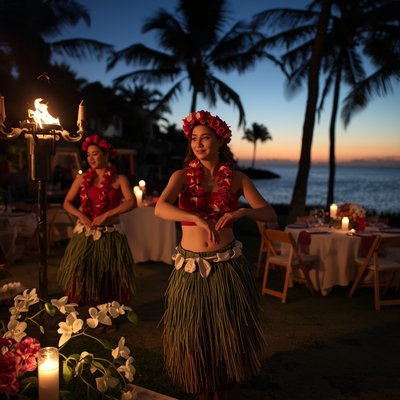
Hula (HOO-lah) at Hawaiian weddings ranges from a solo performance by the bride to full troupe presentations featuring 6-20 dancers, serving as both entertainment and spiritual expression through movement, chant, and music that tells stories of love, nature, and ancestral connection. Professional hula performance costs range from $500-$3,000 USD depending on the number of dancers, performance length (typically 15-45 minutes), and whether the troupe performs hula kahiko (ancient style) or hula ‘auana (modern style) or both.
Hula kahiko (ancient hula) is performed to chanting and percussion instruments including the ipu (gourd drum), pahu (sharkskin drum), and ‘ili’ili (river stones used as castanets). This style predates Western contact and carries deep spiritual significance – each movement is a word, each gesture tells a story, and the chant connects the dancers to the gods and ancestors. Hula kahiko at weddings is powerful and solemn, often performed as a blessing rather than entertainment. The dancers wear traditional kapa cloth or ti leaf skirts, kukui nut lei, and fern head wreaths.
Hula ‘auana (modern hula) is performed to melodic Hawaiian music with ukulele, guitar, and singing, featuring the flowing graceful movements most people associate with hula. This style evolved after Western contact and incorporates a wider range of emotional expression. Hula ‘auana is the more common choice for wedding receptions due to its accessible beauty and the romantic themes of many accompanying songs. Dancers wear holoku (long formal dresses) or colorful modern costumes.
Many couples hire halau hula (hula schools) whose kumu hula (hula teacher) can curate a performance specifically for the wedding, selecting dances and chants that honor the couple’s story, their families’ islands of origin, and the spiritual themes of the ceremony. Some brides learn a hula to perform for their groom at the reception – a deeply personal gesture that takes 2-3 months of lessons ($300-$600 USD) to prepare.
Hawaiian Music and Entertainment
Hawaiian wedding music encompasses traditional chants (oli and mele), slack-key guitar (ki ho’alu), steel guitar, ukulele, and contemporary Hawaiian vocal performances, creating a sonic landscape that ranges from ancient spiritual invocations to modern love songs. Live Hawaiian music for a full reception (3-5 hours) costs $1,500-$5,000 USD for a band or ensemble, with smaller ukulele-guitar duos available for $500-$1,500 USD.
Slack-key guitar (ki ho’alu, meaning “loosen the key”) is a uniquely Hawaiian instrumental tradition where guitar strings are tuned to open chords, producing the warm, cascading sound synonymous with Hawaiian music. Each slack-key master develops their own tuning, and many tunings are family secrets passed down through generations. Having a slack-key guitarist at a wedding is considered a cultural honor, and renowned players command $1,000-$3,000 USD for a reception appearance.
Steel guitar (kika kila), developed in Hawaii in the 1880s, adds its distinctive gliding tones to wedding reception music. The combination of slack-key guitar, steel guitar, ukulele, and upright bass forms the classic Hawaiian ensemble sound.
Popular Hawaiian wedding songs beyond the ceremony include:
- “Aloha ‘Oe” (composed by Queen Lili’uokalani, Hawaii’s last reigning monarch)
- “Pua Lililehua” (traditional love song)
- “E Ku’u Morning Dew” (by Eddie Kamae)
- “Henehene Kou ‘Aka” (playful love song, popular for first dances)
- “Maui Girl” (contemporary island classic)
- “White Sandy Beach” (by Israel Kamakawiwo’ole)
Ohana Traditions and Toasts
Ohana (oh-HAH-nah), meaning family in its broadest sense – encompassing blood relatives, chosen family, and community – drives the social structure of Hawaiian wedding receptions. Unlike mainland receptions where the couple is the exclusive center of attention, Hawaiian receptions distribute honor across the entire ohana through structured acknowledgment, communal participation, and intergenerational respect.
The reception typically opens with a pule (blessing) over the food, offered by the kahu or a respected family elder. Toasts follow Hawaiian protocol, beginning with the eldest family members and proceeding through the generations. Hawaiian toasts often incorporate proverbs (‘olelo no’eau) such as “He ali’i ka ‘aina, he kauwa ke kanaka” (The land is the chief, man is its servant), grounding the celebration in Hawaiian values of humility and connection to place.
A distinctive Hawaiian reception tradition is the money dance, where guests pin currency to the couple’s clothing while dancing with them, with the couple typically collecting $500-$3,000 USD depending on guest count and generosity. This practice parallels similar traditions in Filipino, Polish, and Greek cultures, though the Hawaiian version often includes the presentation of lei alongside cash gifts.
Traditional Wedding Attire: Holoku, Aloha Shirts, and Ceremonial Dress
Bridal Attire and the Holoku Gown
Holoku (HOH-loh-koo) is a formal Hawaiian gown with a fitted bodice and flowing train, originally adapted from the modest dresses introduced by New England missionaries in the 1820s but transformed by Hawaiian women into an elegant garment reflecting island aesthetics. The holoku is the most traditional choice for Hawaiian brides who want to honor cultural heritage while wearing a formal wedding gown, costing $1,000-$5,000 USD for custom designs from Hawaiian seamstresses and designers.
The holoku features a high neckline, fitted waist, and a long flowing skirt with a train – it is distinctly different from the casual muumuu despite sharing historical origins. The formal holoku is made from high-quality fabrics (silk, satin, or fine cotton) and may feature Hawaiian quilting patterns, embroidered tropical motifs, or lace detailing. White remains the most popular color for wedding holoku, though ivory, cream, and soft pastels are also traditional.
Modern Hawaiian brides choose from several attire approaches:
- Traditional holoku: Full-length formal Hawaiian gown ($1,000-$5,000 USD)
- Western gown with Hawaiian elements: Standard bridal dress accessorized with haku lei (flower crown), maile or pikake lei, and barefoot sandals ($500-$5,000+ USD)
- Muumuu: The casual flowing dress for informal beach ceremonies ($100-$500 USD)
- White resort wear: Contemporary tropical formal wear for destination weddings ($200-$1,000 USD)
Regardless of dress choice, the bride’s flower adornments are considered essential. The haku lei (flower crown) costs $75-$250 USD and typically features orchids, tuberose, pikake, and ferns woven onto a base of ti leaves or banana fiber. The haku lei frames the bride’s face and photographs beautifully in the golden Hawaiian light, making it one of the most visually distinctive elements of Hawaiian wedding attire.
Groom and Wedding Party Attire
Aloha shirt (also called Hawaiian shirt) is the standard formal menswear for Hawaiian weddings, with grooms typically wearing white or cream aloha shirts paired with khaki or white linen pants and a maile lei, costing $50-$300 USD for quality shirts and $100-$500 USD for the complete outfit. The aloha shirt became acceptable formal wear in Hawaii through the “Aloha Friday” movement of the 1960s and is now recognized as appropriate for virtually all occasions in the islands, including weddings, funerals, and business meetings.
Groomsmen coordinate in matching aloha shirts, often in a complementary color or pattern to the groom’s white, with popular choices including navy, sage green, or coral prints. A kukui nut lei for each groomsman costs $20-$60 USD and adds cultural authenticity to the ensemble.
For couples seeking more traditional Hawaiian attire, the malo (loincloth) and kihei (shoulder cape) represent ancient Hawaiian formal dress, though these are rarely seen at modern weddings except in highly traditional ceremonies or cultural performances. A more practical traditional option is the lavalava (wraparound cloth) paired with a bare chest and lei for men, similar to attire found in other Polynesian wedding traditions like Samoan and Fijian ceremonies.
Bridesmaids typically wear matching Hawaiian print dresses, holoku in coordinating colors, or solid-colored dresses with flower accessories. The cost ranges from $100-$400 USD per bridesmaid outfit. Flower girls often wear white muumuu with haku lei, while ring bearers don miniature aloha shirts.
Cultural Protocols: Respect, Mana, and the Aloha Spirit
Understanding Mana and Kapu
Mana (MAH-nah) is the spiritual power or life force that Hawaiian culture recognizes in all living things, places, and significant objects, and understanding mana is essential to conducting a respectful Hawaiian wedding. Ceremonies that follow proper cultural protocol are believed to carry strong mana, blessing the marriage with spiritual protection and vitality. Mana flows through the land (aina), the ocean (moana), the kahu’s prayers, the lei flowers, and the love of gathered ohana.
Kapu (KAH-poo), meaning sacred restrictions or taboos, governs certain aspects of Hawaiian ceremony. While the ancient kapu system was officially abolished in 1819, cultural protocols descended from it still inform Hawaiian wedding practices. Key protocols include:
- Ask permission before using sacred sites: Many beach and mountain ceremony locations are culturally significant. Consult with local Hawaiian cultural practitioners or the Office of Hawaiian Affairs before conducting ceremonies at sites with historical or spiritual importance.
- Do not remove natural materials without permission: Taking sand, rocks, shells, or plants from Hawaiian lands for ceremony use requires awareness of both environmental law and cultural protocol.
- Respect the ceremony space: Guests should not cross the ceremonial area before the kahu has blessed it. Phone silence during pule and oli is considered essential respect.
- Follow the kahu’s guidance: The kahu sets the spiritual tone and protocol. Guests should follow instructions regarding when to stand, sit, or participate.
- Acknowledge the host culture: For non-Hawaiian couples holding destination weddings, incorporating genuine Hawaiian elements with understanding and respect – rather than superficial decoration – demonstrates aloha.
Cultural Sensitivity for Destination Weddings
Hawaii is the most popular wedding destination in the United States, hosting approximately 25,000 destination weddings annually, and this volume has created tensions between the tourism industry and Hawaiian cultural practitioners over the authentic versus commercial use of Hawaiian traditions. Couples planning Hawaiian weddings – particularly those without Hawaiian ancestry – have a responsibility to approach Hawaiian cultural elements with genuine respect rather than treating them as exotic entertainment.
Guidelines for culturally respectful Hawaiian destination weddings:
- Hire Hawaiian cultural practitioners: Choose a kahu, musicians, and hula performers who are part of the Hawaiian community, not hotel entertainment staff performing scripted “luau shows.”
- Learn pronunciation: Making the effort to correctly pronounce Hawaiian words in vows and ceremony elements shows respect. Hawaiian language pronunciation follows consistent rules and is accessible with practice.
- Understand what you’re incorporating: If including a lei exchange, learn about lei significance. If having hula, understand it is a spiritual practice, not just dancing.
- Support Hawaiian businesses: Source lei, flowers, food, and services from Hawaiian-owned businesses when possible.
- Be mindful of location impact: Beach ceremonies can damage dune ecosystems. Reef-safe sunscreen, stay on designated paths, and leave no trace.
- Avoid cultural appropriation: Do not wear sacred items as costume (such as traditional tattoo patterns without cultural connection) or misrepresent ceremonies as something they are not.
Many Hawaiian kahu welcome non-Hawaiian couples who approach their culture with genuine interest and respect, and they will thoughtfully guide couples toward appropriate cultural inclusions based on the couple’s backgrounds and connection to Hawaii.
Modern Adaptations and Destination Wedding Considerations
Destination Wedding Logistics
Hawaii’s location – 2,400 miles from the U.S. mainland – makes logistics a central concern for wedding planning. Couples must navigate island selection, weather patterns, vendor coordination, and the significant travel costs their guests will incur. The average destination wedding in Hawaii costs $25,000-$50,000 USD for 50-100 guests, not including guest travel expenses.
Island selection significantly impacts the wedding experience:
- Oahu (most popular, home to Waikiki and Honolulu): Greatest variety of venues from beach to ballroom, most accessible flights and infrastructure. Best for guests who want activities beyond the wedding. Wedding venue costs: $3,000-$15,000 USD.
- Maui (second most popular): Known for dramatic sunset ceremonies, luxury resorts, and natural beauty. Smaller guest capacity at most venues. Wedding venue costs: $5,000-$20,000 USD.
- Big Island (Hawaii Island): Most diverse landscapes including volcanic terrain, rainforest, and ranch country. Fewer tourists, more authentic cultural experiences. Wedding venue costs: $2,000-$12,000 USD.
- Kauai (Garden Isle): Lush tropical scenery, dramatic Na Pali Coast backdrops. Intimate scale, fewer large venues. Wedding venue costs: $3,000-$15,000 USD.
- Molokai and Lanai: Small, intimate islands ideal for elopements and micro-weddings. Limited vendor options but unmatched privacy. Wedding venue costs: $1,000-$8,000 USD.
Weather considerations: Hawaii’s dry season (April-October) offers the most reliable weather for outdoor ceremonies, with temperatures between 75-85 degrees Fahrenheit. The wet season (November-March) brings more rainfall, particularly on windward (northeast-facing) coasts, though showers are typically brief. Sunset ceremony times vary from approximately 6:00 PM in winter to 7:15 PM in summer. Trade winds are consistent and can affect beach ceremonies – windward locations may require hair and veil contingency plans.
Marriage license requirements: Hawaii requires no blood test or waiting period. Couples must apply for a license ($60 USD as of 2024) through the Hawaii Department of Health, and the license is valid for 30 days. Both parties must appear in person with valid government ID. The kahu or officiant files the completed license after the ceremony.
How Hawaiian Weddings Differ from Mainland American Weddings
Hawaiian weddings differ from mainland American traditions in several fundamental ways that reflect the unique cultural position of Hawaii as both a U.S. state and a distinct Polynesian society:
Spiritual framework: Mainland American weddings typically operate within Judeo-Christian or secular frameworks. Hawaiian weddings layer these with indigenous Hawaiian spirituality – the ceremony is not just a legal or religious event but a spiritual alignment with the land, ancestors, and natural forces. The kahu’s role encompasses more spiritual responsibility than a typical mainland officiant.
Relationship with place: Mainland weddings happen at a venue. Hawaiian weddings happen in relationship with the aina (land). The beach is not just a backdrop – it is a participant. The ocean, the wind, the volcanic earth beneath bare feet are all part of the ceremony’s spiritual fabric. This is why many kahu begin ceremonies by acknowledging and honoring the specific place where the wedding occurs.
Attire expectations: Mainland weddings often involve strict formal dress codes. Hawaiian weddings embrace relaxed elegance – barefoot ceremonies on sand, aloha shirts as formal wear, flower crowns instead of tiaras. This informality is not casualness but a different cultural understanding of how to honor an occasion.
Community orientation: Mainland American weddings have become increasingly couple-centric. Hawaiian weddings retain a stronger orientation toward ohana and community, with reception traditions that honor elders, include children as active participants, and distribute joy across the gathering rather than concentrating it exclusively on the couple.
Time orientation: Mainland weddings often follow tight schedules with ceremonies lasting 15-30 minutes. Hawaiian ceremonies run on “Hawaiian time” – not carelessness about punctuality but a cultural comfort with letting sacred moments take the time they need. A kahu will not rush a pule because the photographer needs sunset light.
Cost comparison: The average mainland American wedding costs approximately $33,000 USD. Hawaiian weddings range widely – a simple beach elopement with a kahu costs $500-$2,000 USD, while a full destination wedding with 100+ guests averages $25,000-$50,000 USD. Many couples find that Hawaiian weddings offer equal or better value because outdoor venues are less expensive than mainland ballrooms, Hawaiian catering (especially luau-style) is cost-effective for large groups, and the setting provides natural decoration that reduces floral and decor expenses.
Elopements and Micro-Weddings in Hawaii
Hawaii has become a leading destination for elopements and micro-weddings (under 20 guests), driven by the islands’ natural beauty, simple licensing requirements, and growing cultural acceptance of intimate ceremonies. An estimated 40% of Hawaiian weddings are now elopements or micro-weddings, with costs ranging from $500-$5,000 USD for complete packages.
A typical Hawaiian elopement includes:
- Kahu/officiant: $300-$800 USD
- Photographer: $500-$2,000 USD (1-2 hours)
- Lei: $50-$200 USD (bride and groom)
- Marriage license: $60 USD
- Location permit (required for some beaches): $0-$100 USD
- Total: $910-$3,160 USD
Elopement-friendly locations include secluded beaches, botanical gardens, waterfall settings, and volcanic landscapes. Many kahu specialize in intimate ceremonies and can create deeply personal 30-45 minute experiences that incorporate full Hawaiian cultural elements without the logistical complexity of large weddings.
The elopement trend has been embraced by Hawaiian cultural practitioners who appreciate couples seeking genuine ceremony over spectacle. Many kahu report that smaller ceremonies allow for deeper spiritual engagement, more meaningful lei exchange, and authentic Hawaiian protocol that large commercial weddings sometimes dilute.
Traditional Hawaiian Music, Chant, and Dance in Weddings
Oli (Chant) and Mele (Song)
Oli (OH-lee) is the Hawaiian tradition of chanting – melodic vocal recitation without musical accompaniment that serves as prayer, history, storytelling, and spiritual invocation. In weddings, oli is typically performed by the kahu or a trained chanter at key ceremonial moments: the opening of the ceremony (oli komo, or entrance chant), during the blessing, and sometimes during the lei exchange. Hiring a dedicated oli chanter costs $300-$800 USD and adds a layer of cultural authenticity that distinguishes the ceremony from commercial Hawaiian wedding packages.
Mele (MEH-leh) means song and encompasses the vast repertoire of Hawaiian vocal music. Wedding mele are selected for their themes of love, devotion, and place. Many traditional mele reference specific locations, natural phenomena, or historical figures, allowing couples to choose songs connected to their ceremony location or personal story. A mele composed specifically for the couple (mele inoa, or name song) is considered the highest honor and costs $500-$2,000 USD from Hawaiian composers.
The distinction between oli and mele is significant: oli is sacred and ceremonial, while mele is celebratory and communal. A wedding that includes both demonstrates deep cultural engagement, moving from the spiritual realm of oli during the ceremony to the joyful realm of mele during the reception.
Traditional Instruments
Hawaiian wedding music features several distinctive instruments:
Ipu (EE-poo) is a gourd drum – either a single gourd (ipu heke ‘ole) or double gourd (ipu heke) – that provides rhythmic accompaniment for hula kahiko and oli. The deep, resonant tones of the ipu ground the ceremony in ancient Hawaiian soundscapes. Professional ipu players are often connected to halau hula and charge $200-$500 USD as part of a ceremony ensemble.
Pahu (PAH-hoo) is a large drum made from a hollowed coconut or breadfruit log with a sharkskin membrane, producing powerful beats that call spiritual attention. The pahu is considered sacred – in ancient Hawaii, it was only played for ceremonies involving ali’i or religious rites. Its inclusion in a wedding ceremony elevates the spiritual significance and is typically reserved for couples with deep Hawaiian cultural connections.
Ukulele (oo-koo-LEH-leh, not “you-ka-lay-lee”) is the most recognizable Hawaiian instrument, adapted from the Portuguese machete brought to Hawaii by Madeiran immigrants in the 1870s. Its bright, cheerful tone is synonymous with Hawaiian celebration, and a skilled ukulele player provides both ceremony and reception music. Professional ukulele performers cost $300-$1,000 USD for ceremony or reception sets.
Flowers, Lei, and Natural Adornment
Haku Lei (Flower Crown)
Haku lei (HAH-koo lay) is a woven flower crown worn by the bride (and sometimes the groom, wedding party, or guests) made by braiding flowers, ferns, and foliage onto a base of ti leaves, raffia, or banana fiber. The haku lei is one of the most visually stunning elements of Hawaiian wedding attire, framing the face with a living crown of tropical beauty. Professional haku lei for brides cost $75-$250 USD depending on flower selection and complexity, with simpler versions for bridesmaids at $40-$100 USD each.
The art of haku lei making is a Hawaiian cultural skill passed through generations, and the best wedding haku lei are made by experienced Hawaiian lei makers who understand which flowers hold up in heat, which combinations photograph well, and which blooms carry cultural significance. Popular haku lei flowers include:
- Orchids: Durable, available in many colors, photograph beautifully
- Tuberose: Intensely fragrant, white, adds volume and texture
- Pikake: Delicate jasmine, traditional bridal flower
- Plumeria: Classic Hawaiian flower, available in multiple colors
- Maile: Sacred green vine, adds cultural depth
- Palapalai fern: Delicate fern associated with Laka, goddess of hula
- Lehua: Red blossom of the ohia tree, sacred to Pele
Haku lei are typically made the morning of the wedding to ensure freshness and are kept refrigerated until use. They last 4-8 hours in Hawaiian heat before wilting begins, making timing coordination with the photographer important.
Floral Ceremony Decorations
Hawaiian weddings leverage the islands’ abundant tropical flora for ceremony decoration, often requiring less purchased decor than mainland weddings because the natural environment provides the backdrop. Common floral elements include:
- Ceremony arch or altar: Made from bamboo, driftwood, or koa wood, decorated with tropical flowers and greenery ($300-$2,000 USD)
- Aisle flowers: Plumeria petals, orchid blooms, or ti leaves lining the ceremony path ($100-$500 USD)
- Tiki torch arrangements: Flanking the aisle with fire and flowers ($200-$600 USD)
- Floating flowers: Blossoms in water features or ocean pools ($100-$300 USD)
- Table centerpieces: Tropical arrangements with protea, bird of paradise, heliconia, and anthuriums ($50-$150 USD each)
The total floral budget for a Hawaiian wedding averages $1,500-$5,000 USD, which is often lower than mainland weddings because the natural setting reduces the need for extensive decoration. Many Hawaiian florists specialize in wedding work and can create cohesive designs incorporating culturally significant plants alongside purely decorative tropical flowers.
How much does a traditional Hawaiian wedding cost?
Traditional Hawaiian weddings range from $500 for a simple beach elopement to $50,000+ USD for a full destination wedding celebration, with the average Hawaiian wedding costing $25,000-$35,000 USD for 75-125 guests. The cost structure differs significantly from mainland American weddings due to Hawaii’s unique venue options, catering traditions, and the relative affordability of outdoor tropical settings compared to ballroom rentals.
Major expense categories include venue rental ($2,000-$20,000 USD, with beach permits as low as $100 USD), catering and luau ($5,000-$25,000 USD for 100 guests), photography and videography ($2,000-$6,000 USD), flowers and lei ($1,500-$5,000 USD), kahu/officiant ($500-$2,000 USD), music and entertainment ($1,000-$5,000 USD), and attire ($500-$5,000 USD for the bride, $100-$500 USD for the groom). Hidden costs specific to Hawaiian weddings include beach or park permits ($100-$500 USD), generator rental for remote locations ($200-$500 USD), and weather backup plans ($500-$2,000 USD for tent rental). Costs are typically shared between the couple, with Hawaiian cultural tradition placing less emphasis on “who pays” compared to mainland conventions.
How long does a Hawaiian wedding ceremony last?
Hawaiian wedding ceremonies typically last 20-45 minutes, significantly longer than the 15-minute mainland average, because the incorporation of Hawaiian cultural elements – pule (prayers), oli (chants), lei exchange, and ring blessings – each adds meaningful time to the proceedings. A simple Hawaiian ceremony with a conch shell opening, brief pule, vows, lei exchange, ring exchange, and closing blessing runs 20-25 minutes. A full cultural ceremony incorporating ti leaf cleansing, extended oli, Hawaiian language vows, sand ceremony, and comprehensive blessings can reach 45-60 minutes. The reception following the ceremony typically runs 4-6 hours, including luau dining (1.5-2 hours), hula performances (30-45 minutes), music and dancing (2-3 hours), and ceremonial toasts and money dance (30-60 minutes). Complete wedding celebrations from the afternoon ceremony through the evening reception last 5-8 hours, with some incorporating morning-after sunrise blessings that extend the celebration to the following day.
What lei should I choose for a Hawaiian wedding?
Lei selection is one of the most significant decisions in a Hawaiian wedding because each lei type carries specific cultural meaning, and the wrong choice can inadvertently convey an unintended message. The groom traditionally wears a maile lei (open-ended fragrant green vine lei, $50-$150 USD), which is the most sacred lei type and symbolizes royalty, respect, and divine connection. The bride traditionally wears a pikake lei (Arabian jasmine, $30-$100 USD for double or triple strand), associated with Hawaiian royalty through Princess Ka’iulani’s love of the flower. The wedding party receives plumeria lei ($15-$40 USD each), which represent new beginnings and welcome. Mothers and grandmothers receive orchid lei ($25-$75 USD) symbolizing refined beauty and respect. Male attendants receive kukui nut lei ($20-$60 USD) representing enlightenment and guidance. Guest lei can be simple plumeria, orchid, or ti leaf lei ($8-$25 USD each). For 100 guests, total lei costs range from $1,000-$3,500 USD. Order lei from Hawaiian lei makers at least 2 weeks in advance, with confirmation 48 hours before the wedding.
Can non-Hawaiian couples have a Hawaiian wedding ceremony?
Non-Hawaiian couples can absolutely have a Hawaiian wedding ceremony, and many Hawaiian kahu warmly welcome the opportunity to share their culture with couples who approach it with genuine respect and understanding. The key distinction is between cultural appreciation (learning about and respectfully participating in Hawaiian traditions) and cultural appropriation (using Hawaiian elements as superficial decoration without understanding or respect). To ensure a respectful ceremony, hire a kahu who is a recognized Hawaiian cultural practitioner rather than a generic officiant reading Hawaiian words phonetically, learn the pronunciation and meaning of any Hawaiian words used in your ceremony, incorporate Hawaiian elements because they hold meaning for you rather than for aesthetic purposes, and compensate Hawaiian cultural practitioners fairly for their expertise and spiritual labor. Many kahu offer pre-wedding consultations ($100-$300 USD) specifically to help non-Hawaiian couples understand which elements are appropriate for their ceremony given their cultural backgrounds and personal connection to Hawaii. Couples who have lived in Hawaii, have Hawaiian family connections, or have a deep personal relationship with the islands may appropriately include more cultural elements than first-time visitors.
What are the best months to have a Hawaiian wedding?
The best months for Hawaiian outdoor weddings are April through October, which constitute Hawaii’s dry season with the most reliable sunshine, lower humidity, and calmer ocean conditions. June through August are the peak wedding months, offering the longest daylight hours (sunset around 7:00-7:15 PM) and the warmest temperatures (80-88 degrees Fahrenheit). However, these months also bring the highest venue costs and greatest competition for vendors. April, May, September, and October offer excellent weather at lower costs, with September and October being particularly favorable for budget-conscious couples as tourism drops after summer. November through March (wet season) brings more frequent rainfall, particularly on windward coasts, but leeward ceremony sites on all islands remain relatively dry. Winter months offer dramatic cloud formations and occasional whale sightings (humpback whales are in Hawaiian waters December through April), trading weather reliability for unique natural spectacle. Regardless of season, morning ceremonies (before 11:00 AM) and late afternoon ceremonies (after 4:00 PM) avoid the strongest midday sun and heat. Always have a rain backup plan – brief showers are common year-round in Hawaii and are culturally considered a blessing (ua, rain, is associated with fertility and abundance in Hawaiian thought).
How do Hawaiian weddings incorporate the ocean?
The ocean is integral to Hawaiian wedding traditions, reflecting the Hawaiian worldview that the sea is not merely a scenic backdrop but a living spiritual force connected to the god Kanaloa and the source of life. Ocean incorporation ranges from simple beach ceremonies with waves as the soundtrack to elaborate traditions involving the water itself. Common ocean elements include ceremony locations at the water’s edge where waves occasionally wash over bare feet (considered a blessing from Kanaloa), the kahu dipping ti leaves or rings in ocean water during blessings, the couple wading into the ocean together after the ceremony for photographs and symbolic cleansing, and sunset ceremonies timed so the sun descends into the Pacific during the closing blessing. Some kahu incorporate a specific ocean blessing where the couple faces the sea while the kahu chants, asking the ocean to carry their commitment across all waters and all time. For couples uncomfortable with sand and surf, oceanfront cliff ceremonies, seaside garden venues, and resort properties with ocean views provide the connection to moana (ocean) without the logistics of beach sand. Ocean safety should be discussed with the kahu and photographer, as wave conditions vary by location and season, and some beaches have strong currents that make post-ceremony ocean wading inadvisable.
What should I know about tipping and vendor etiquette in Hawaii?
Tipping and vendor etiquette in Hawaiian weddings reflects the island’s unique blend of professional service industry standards and Hawaiian cultural values of generosity and reciprocity. Standard tipping guidelines are 15-20% for catering staff, $50-$200 per musician, $100-$500 for the lead photographer, and 15-20% for hair and makeup artists. The kahu represents a special consideration – many Hawaiian cultural practitioners view their role as spiritual service rather than commercial transaction, and some decline tips while others accept them graciously. Ask your wedding coordinator about specific kahu preferences. An alternative to tipping the kahu is presenting a meaningful gift such as a koa wood item ($50-$200 USD) or making a donation to a Hawaiian cultural preservation organization in their name. For luau catering, tip the pit master and cooking crew separately from the serving staff ($100-$300 for the pit crew). Vendor communication in Hawaii often moves at a different pace than mainland business – responses may take longer, and relationships are valued over transactions. Building personal rapport with vendors through genuine aloha rather than purely transactional communication yields better results and reflects the cultural context.
What is the significance of the conch shell at Hawaiian weddings?
The conch shell (pu) holds deep historical and spiritual significance in Hawaiian culture, serving as a communication instrument, ceremonial announcer, and spiritual tool for centuries before Western contact. In ancient Hawaii, the pu was blown to announce the arrival of ali’i (royalty), signal the beginning of important ceremonies, communicate across valleys and between islands, and mark transitions between sacred and ordinary time. At weddings, the pu serves all these functions simultaneously – it announces the ceremony as an event of importance, signals the transition from gathering time to sacred time, communicates to the spiritual realm that a significant union is occurring, and creates an acoustic marker that guests consistently describe as the most emotionally powerful moment of the wedding. The pu is typically blown three times with specific intentions: the first blast honors ancestors and the past, the second honors the present moment and gathered loved ones, and the third honors the future the couple will create. The person blowing the pu must have training – producing a clear, sustained tone requires proper embouchure and breath control, and an inexperienced attempt can produce weak or sputtering sounds that diminish the ceremony’s dignity. Professional pu blowers charge $100-$300 USD and often serve as the ceremony’s opening act, standing at the far end of the aisle or on an elevated point where the sound can carry across the ceremony space and out to sea.
For more information about Hawaiian cultural preservation and traditional practices, visit the Office of Hawaiian Affairs, which supports programs preserving Hawaiian language, culture, and traditions across the islands.