Jewish Wedding Traditions: A Celebration of Love, Faith, and 3,000 Years of "L'Chaim!"
When Your Mother-in-Law Breaks a Plate (And Everyone Cheers)
Jewish tradition understands that sometimes you need to break things to build them.
The journey begins at the vort (engagement party), where both mothers raise a ceramic plate overhead like an offering, then smash it to smithereens while the crowd roars approval. This tenaim (engagement contract) ceremony makes a declaration: like those shards scattered across the floor, this commitment is irreversible. Done. Final.
Pro Tip: Modern couples collect every shard, commissioning artists to embed them in mezuzahs or sculptures. One Brooklyn couple had theirs made into a chandelier, now their broken beginning literally illuminates their home.
Orthodox couples might stage this destruction months early, triggering preparation that’s part spiritual awakening, part logistical nightmare. Couples study ancient texts while spreadsheet-wrestling seating charts. They meet with rabbis while arguing about centerpieces. And in traditional communities, they’ll stop seeing each other the entire week before the wedding. Not a text. Not a glimpse. Nothing. The tension builds intensely.
Budget Note: Engagement parties range widely based on family traditions and preferences, from intimate living room gatherings to full synagogue events. The plate? Often the ugliest one available. Families compete to find patterns so hideous that breaking them feels like community service.
The aufruf (calling up) arrives the Shabbat before the wedding. The groom reads Torah while mentally reviewing his vows. Then, chaos. The congregation bombards him with candy. Tootsie Rolls rain from the balcony. Hershey’s Kisses ricochet off prayer books. One grandmother always brings those strawberry hard candies that nobody under seventy actually eats. It’s beautiful: grown adults with graduate degrees throwing sweets at a man in a prayer shawl, shouting “Mazel Tov!” It’s how Jews have said “we’re happy for you” for generations.
The Tisch: Where Men Sing, Cry, and Sign Your Marriage Contract
Forget Vegas. The Jewish groom gets a tisch (groom’s table), imagine a gathering run by rabbis, fueled by herring instead of beer pong.
Men pack around tables with whiskey and mysteriously sourced fish products. The groom attempts to speak about Torah: “The Talmud says about marriage–” NOPE. The crowd explodes into song. He tries again. More singing. It’s loving sabotage, designed to keep him humble while his joy reaches dangerous levels.
Someone’s grandfather tells that story about meeting grandma at the DP camp. Everyone knows every word. Nobody mentions it. There are tears camouflaged as allergies. The singing reaches volumes that violate noise ordinances. Men who haven’t cried in years are suddenly weeping into their schnapps.
Musical Note: Don’t know the words? Bang the table and yell “YA-DA-DAI-DAI” whenever others do. You’re now fully participating in a tradition older than most countries.
Simultaneously, the bride holds court at kabbalat panim (reception of faces), enthroned like royalty. She’s fasted since dawn in some traditions, her dress cost more than expected, and she’s fielding advice ranging from profound (“Marriage is a marathon, not a sprint”) to problematic (“Always keep your passport updated, just in case”).
Then: the badeken (veiling ceremony).
The groom, escorted by what appears to be a flash mob of singing Jews, approaches his bride. Their eyes meet after seven days apart. He lowers the veil. Someone’s definitely chopping onions nearby, that’s the only explanation for why everyone’s crying, including the bartender. This tradition exists because Jacob married the wrong sister due to poor veil visibility. Millennia later, Jewish grooms remain vigilant. The bride tries not to laugh. She usually fails.
Budget Note: Tisch catering varies widely. Or go authentic: folding tables, plastic cups, and someone’s cousin’s “famous” chopped liver. The singing sounds identical either way.
Standing Under a Canopy While Everyone Tries Not to Cry
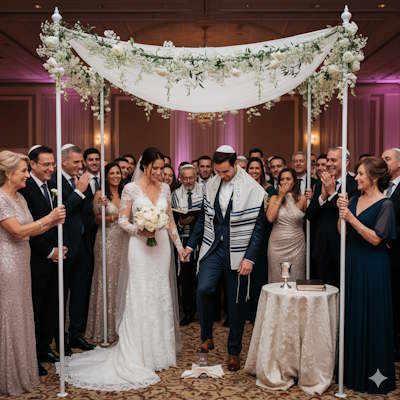
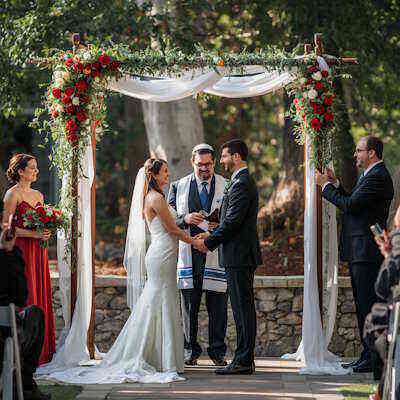
The chuppah (wedding canopy) seems modest: four poles, a cloth roof, open sides. Don’t be fooled. This fragile structure holds the weight of every Jewish union since ancient times. Some couples use a grandfather’s tallit (prayer shawl) that survived unspeakable history. Others commission floral fantasies that belong in museums. Regardless, when the couple stands beneath it, they’re not just marrying, they’re architecting a future while everyone watches. For modern Israeli weddings, the chuppah often takes place outdoors under the stars, following the blessing given to Abraham.
Real Wedding Story: “During our beach ceremony, the wind went rogue. All four chuppah-holders leaned in simultaneously, fighting to keep grandpa’s tallit earthbound. For one perfect moment, our families literally held our future together against the storm. The photos look like a Renaissance painting. The crying was… extensive.” - Sarah, Miami
The processional alone requires a GPS. Jewish tradition includes both sets of parents, step-parents, grandparents, great-aunt Sylvia who insists she’s basically a grandparent, and enough attendants to populate a small kibbutz.
Then the bride circles the groom seven times. Or three. Depends who you ask. Mystics say she’s weaving an invisible wall of protection. Pragmatists note it’s excellent cardio before a large meal. In egalitarian ceremonies, they circle each other until everyone’s dizzy and symbolism has been achieved.
Good to Know: The circling represents either the seven days of creation, the walls of Jericho, or the bride marking her territory. All interpretations have their advocates.
Kiddushin (sanctification) follows, the actual “getting married” bit. The groom slides a ring onto the bride’s finger while declaring in Hebrew and English: “Behold, you are consecrated to me with this ring according to the law of Moses and Israel.” The ring must be plain metal, no stones, no flash. Ancient contract law demanded transparent value. No hidden diamonds, no surprise appraisals. It’s aggressive honesty, which explains why Jewish marriages survive everything from wandering in deserts to wandering in Costco.
Someone reads the ketubah (marriage contract). In Aramaic. A language no longer spoken conversationally. It’s like having your prenup recited in hieroglyphics, except this document protected women’s rights before women’s rights were even a concept. According to the Orthodox Union’s guide to Jewish weddings, the ketubah outlines the husband’s obligations to his wife and has been a cornerstone of Jewish marriage for over two thousand years. Modern ketubahs often become art pieces and hang in living rooms, where guests ask, “Is that calligraphy or did someone sneeze ink?”
The sheva brachot (seven blessings) connect this specific wedding to creation itself, to the Garden of Eden, to the rebuilding of Jerusalem. No pressure whatsoever.
The Moment Everyone's Been Waiting For: The Glass
The blessing ends. Silence falls. The groom raises his foot above a wrapped glass. The guests hold their breath.
CRUNCH.
“MAZEL TOV!“
The eruption could register on seismographs. Grandmothers who haven’t raised their voices in years are suddenly screaming. Teenage cousins who spent the ceremony on TikTok are jumping like they’re at Coachella. The party has officially, irreversibly, begun.
Pro Tip: Smart couples save the shards for artwork. One couple had theirs embedded in their ketubah frame. Another made mezuzah covers. Someone in Portland probably made artisanal coasters. Breaking things is now a cottage industry.
Why smash glass at peak happiness? Depends who you ask. Traditionalists say it remembers the Temple’s destruction, joy tempered with history. Philosophers see relationship fragility requiring careful handling. A Brooklyn rabbi once quipped: “Look, it’s the last thing he’ll break without sleeping on the couch.”
The couple immediately disappears for yichud (seclusion), their first moments alone as spouses. They hide in a private room while two witnesses guard the door because Jewish law requires witnesses for everything, including privacy. Inside, they break their fast, fix their lipstick, and whisper variations of “We actually did it.” It’s often the only food they’ll eat until someone’s aunt force-feeds them brisket at midnight.
Survival Tip: EAT DURING YICHUD. You’re about to be human pinballs bouncing between relatives for hours. This is your only chance for actual nutrition.
When Your Reserved Aunt Suddenly Leads the Conga Line
Jewish receptions are where inhibitions go to die beautiful deaths.
The band strikes up. Your accountant cousin attempts Cossack kicks. Your grandmother demands chair elevation. That uncle with two hip replacements? He’s leading a conga line wearing someone’s centerpiece as a crown. This is what happens when ancient tradition meets open bar.
Fun Fact: The hora (circle dance) requires no skill, only enthusiasm. Join the circle, grab whoever’s nearby, shuffle sideways. The mob provides momentum. Resistance is both futile and offensive. The hora shares roots with similar circle dances found in Greek weddings and other Mediterranean celebrations.
The chair dance transforms into WWE wrestling with formal wear. The couple gets hoisted skyward while clutching a napkin between them (Orthodox couples maintain boundaries even while airborne). Below, a human hurricane of relatives sings, sweats, and prays nobody’s been skipping leg day. It looks like extremely well-dressed crowd-surfing. Your bubbie started the mosh pit.
Guest Count: Jewish weddings often have large guest lists. “Intimate” might mean what others call medium-sized. “Small” means only one side of the family plus their dentists. The philosophy: better to have your barista there than risk anyone feeling excluded.
In Hasidic weddings, the mitzvah tantz (mitzvah dance) creates surreal beauty, male relatives dance before the seated bride while holding a rope, maintaining modesty while expressing ecstasy. Each man’s style reflects his soul: grandfathers shuffle, brothers leap, uncles do that thing where they pretend their knees still work. The bride remains still, a queen receiving kinetic tribute.
Money Matters: Jewish wedding bands possess supernatural abilities to play “Hava Nagila” directly into “Single Ladies” without missing a beat. It shouldn’t work. It absolutely does.
The Seven Days When Dinner Parties Become Competitive Sport
Wedding ends at 2 AM. Couple collapses at 3 AM. Phone rings at 8 AM: “Darlings! Tonight! My house! I’m making the brisket!”
Welcome to sheva brachot (seven blessings) week, seven nights of competitive hosting where your loved ones try to prove their love through increasingly aggressive hospitality.
Rules: You need ten Jewish adults (minyan) and one person who wasn’t at the wedding (fresh audience for stories). It’s basically wedding afterparties for a full week, except your aunt’s competing with your mother-in-law and there’s a brisket arms race happening.
Time Management: Coordinating seven dinners with jet-lagged relatives who all have opinions? It’s three-dimensional chess with guilt as a playing piece.
By Wednesday, patterns emerge. Monday served chicken, so Tuesday makes lamb. Wednesday breaks out wedding china. Thursday hires staff. By Friday, someone’s built a chocolate fountain in their foyer while mentioning how “homey” Tuesday’s paper plates were.
Beyond the food (though my God, the food), each meal becomes story time. The embarrassing college years. The failed first date. The time he accidentally proposed to her roommate. (Language barrier. Tequila. Don’t ask.) The couple discovers everyone knew they’d marry before they did, including the doorman.
Cost Note: Hosts invest significantly in these meals. Smart communities potluck, though this risks the “Great Kugel Redundancy” where everyone brings the same dish.
Why Modern Couples Are Mixing Ancient Traditions with Contemporary Aesthetics
Today’s Jewish weddings are beautiful identity expressions. Couples livestream ceremonies to Florida while following laws from ancient Babylon. They sign ketubahs on iPads but break the glass wrapped in great-grandfather’s tallit. Molecular gastronomists reimagine gefilte fish while the challah recipe remains untouched since the shtetl.
Celebration Tip: “Unplugged ceremonies” are trending, using ancient tradition to encourage presence over phone screens. Moses would kvell.
Ketubahs became high art. Couples commission pieces with abstract expressionism meeting ancient Aramaic. They hang above sofas, making guests wonder if it’s religious text or expensive wallpaper.
The Vibe: Each denomination adapts differently. Orthodox weddings separate dancers with a mechitza (partition), creating competitive dance-offs. Reform ceremonies might feature the bride’s college roommate reading Mary Oliver between blessings. Conservative Jews split the difference. Like Hindu weddings with their rich denominational diversity, Jewish celebrations adapt traditions to community preferences.
Gender roles are evolving at light speed. Female rabbis officiate wearing gorgeous tallitot. Same-sex couples each break glasses (stereo celebration!). Interfaith couples blend traditions so seamlessly that guests can’t identify where Judaism ends and other traditions begin. These aren’t museum pieces, they’re living practices that somehow maintain essential meaning while reflecting who we’ve become.
Questions Every Guest Has But Is Too Polite to Ask
Why do Jewish weddings always run late?
Jewish Standard Time isn’t a joke, it’s a mathematical principle. Take the invitation time, add: tisch (extra time), badeken (more time), ketubah signing (more time), photos (substantial time), Uncle Morty parking (considerable time). That 6 PM start? Realistically expect 7:15-7:
- Veterans arrive strategically, hit the cocktail hour that’s already in full swing, and settle in. Some couples print earlier times on invitations just to get people there by the actual start time. It’s a cultural arms race of lateness.
What’s the deal with the chair dancing, and what if they drop someone?
The chair lifting looks like a lawsuit waiting to happen, but here’s the thing: Jewish communities have been hoisting brides and grooms skyward for centuries with surprisingly few incidents. The secret: strategic strong-person placement and knowing when grandma’s had enough altitude. Most bands can read the room, they know when the college friends are getting too ambitious with their space program. Being asked to lift is an honor and a quad workout. Plant feet, bend knees, pray.
How much money should I give as a wedding gift?
Jewish wedding gifts follow the mystical mathematics of chai (life), which equals 18. So gifts come in multiples: $180, $360, $540, depending on your relationship to the couple. The unspoken formula: cover your plate plus an actual gift. Close family gives more, distant cousins give less, and everyone pretends not to be doing mental arithmetic during the cocktail hour. Cash is common in Jewish wedding culture; registries exist, but that envelope in your jacket pocket matters.
What should I wear to a Jewish wedding?
Think “synagogue appropriate meets dance floor ready.” Women: cover your shoulders for the ceremony (bring a pashmina, you’ll see many of them draped over chairs by dessert time). Skip the plunging necklines and micro-minis. Avoid white (bride’s color). Men: suit up, and you’ll need a kippah which lives in a basket by the door.
Here’s the real intel: bring comfortable shoes or stash ballet flats in your purse. You will dance. Not “might dance” or “maybe one song”, you WILL be dragged into multiple horas whether you know the steps or not. Those gorgeous stilettos? They’ll be abandoned under your table by mid-evening while you’re spinning in a circle in your stockings. Similar to Islamic wedding celebrations, modest dress is appreciated during the ceremony itself.
Is it true that men and women can’t dance together at Orthodox weddings?
Orthodox weddings separate dancers with a mechitza (partition). It’s not suppression, it’s liberation from trying to look impressive while doing the hora. Both sides go equally hard. The women’s side gets wild. The couple watches from their elevated chairs like beloved overlords. Mixed socializing happens during non-dance moments.
What if I don’t know Hebrew, will I understand anything?
Most weddings include English translations. The physical stuff (circling, rings, glass-smashing) translates universally. Follow the crowd: stand, sit, shout “Mazel Tov!” Nobody expects perfection. Your presence matters more than pronunciation.
Why does everyone keep talking about the food at Jewish weddings?
Because Jewish wedding food is competitive eating disguised as celebration. The cocktail hour alone could be Thanksgiving. Then actual dinner. Then the Viennese table appears like a dessert mirage. Around midnight, someone wheels out a breakfast station because God forbid someone’s hungry at 1 AM. This isn’t excess, it’s theology. Feeding guests well is a mitzvah, and Jewish mothers have been competing at this particular mitzvah since the Temple stood.
The Bottom Line: It's Organized Chaos, and It's Perfect
Jewish weddings are impossible contradictions that somehow work: meticulously planned disasters, ancient modern experiences, sacred ridiculousness. Where else does breaking things bring luck, contracts become art, and your podiatrist attempts the splits?
The chaos IS the point. When the crowd sings off-key while your reserved dentist attempts interpretive dance and someone’s grandmother demands another chair ride, you’re not watching a party malfunction. You’re witnessing what happens when an entire community decides that love deserves total, complete, unhinged celebration.
These weddings carry history, every broken glass echoes through time, every blessing connects to ancestors, every dance step follows grooves worn by countless celebrations. Yet they’re viscerally present, creating tomorrow’s stories, next generation’s puzzlement.
Here’s what you need to know: You’ll dance more than planned. Cry more than expected. Eat more than possible. It starts late, runs long, and somewhere you’ll find yourself in a sweaty circle of strangers singing words you don’t understand with shocking enthusiasm.
When that glass shatters and everyone screams “Mazel Tov!”, you’ll get it. This isn’t just a wedding. It’s ancient wisdom turned into pure joy. It’s proof that some things last not because they’re old but because they work. Generations of tradition just kicked down your door to throw history’s best party.
L’Chaim! To life, to love, and to the beautiful madness of Jewish weddings.
Frequently Asked Questions
What is a Jewish wedding chuppah?
A chuppah is the wedding canopy under which Jewish marriage ceremonies are performed. It consists of a cloth or tallit (prayer shawl) stretched or supported over four poles, symbolizing the couple's new home together. The chuppah is open on all sides, representing the hospitality that Abraham and Sarah showed to guests in their tent. Couples often personalize their chuppah with family heirlooms, flowers, or meaningful fabrics.
Why do Jewish couples break a glass at their wedding?
The breaking of the glass at a Jewish wedding serves multiple symbolic purposes. Primarily, it reminds us that even in our greatest moments of joy, we remember the destruction of the Temple in Jerusalem. It also represents the fragility of human relationships and the care they require. When the groom (or both partners) steps on the glass wrapped in cloth and it shatters, guests shout 'Mazel Tov!' marking the official beginning of the celebration.
What is a ketubah in a Jewish wedding?
A ketubah is the Jewish marriage contract, traditionally written in Aramaic, that outlines the groom's responsibilities to his bride. This ancient document, which predates most prenuptial agreements by thousands of years, was designed to protect women's rights in marriage. Modern ketubahs often feature beautiful artwork and egalitarian language. The ketubah is signed before the ceremony by the couple and two witnesses, then often displayed as art in the couple's home.
How long does a Jewish wedding ceremony last?
The Jewish wedding ceremony itself typically lasts 20-30 minutes, but the entire wedding celebration often extends 5-6 hours. The day includes pre-ceremony rituals like the tisch (groom's reception) and bedeken (veiling ceremony), the ceremony under the chuppah, yichud (private time for the couple), and an extensive reception with dinner and dancing. Orthodox weddings may run even longer with separate receptions and extended dancing.
What happens during the seven days after a Jewish wedding?
The seven days following a Jewish wedding are called sheva brachot, during which friends and family host festive meals for the newlyweds. At each meal, the seven wedding blessings are recited again in the presence of a minyan (10 Jewish adults) and someone who wasn't at the wedding. These celebrations extend the wedding joy throughout the week and allow the community to continue honoring the couple. Each meal becomes an opportunity for additional toasts, stories, and blessings.
Why do Jewish brides circle the groom seven times?
The bride traditionally circles the groom seven times under the chuppah, though some traditions call for three circles. This practice has multiple interpretations: it represents the seven days of creation, the seven times Joshua circled the walls of Jericho, and the bride building a protective wall around their relationship. In egalitarian ceremonies, couples may circle each other. The circling creates a sacred space for the couple and symbolically defines the boundaries of their new union.
What is the badeken ceremony at a Jewish wedding?
The badeken is the veiling ceremony where the groom personally places the veil over his bride's face before the wedding ceremony. This tradition stems from the biblical story of Jacob, who was tricked into marrying Leah instead of Rachel because he couldn't see her face through the veil. By veiling the bride himself, the groom ensures he's marrying the right person. This emotional moment often involves singing, dancing, and the groom being escorted by musicians and friends to see his bride for the first time that day.
Do Jewish couples see each other the week before the wedding?
In Orthodox and some Conservative Jewish traditions, couples don't see each other for the entire week before their wedding. This separation period builds anticipation and allows for spiritual preparation. The couple reunites at the badeken (veiling ceremony) just before the wedding, making this moment particularly emotional. Reform and secular Jewish couples may not observe this tradition, though some choose a modified version, avoiding each other for just a day or two before the wedding.
What is an aufruf in Jewish wedding tradition?
An aufruf (meaning 'calling up' in Yiddish) occurs on the Shabbat before the wedding when the groom, and sometimes the bride, is called up to the Torah for an aliyah (blessing over the Torah reading). After the blessing, the congregation celebrates by throwing soft candy at the couple, symbolizing the sweetness of married life. This tradition publicly announces the upcoming wedding to the community and allows them to offer their blessings and support.
What happens during yichud at a Jewish wedding?
Yichud (meaning 'seclusion' in Hebrew) is the Jewish tradition where newlyweds spend their first moments alone together immediately after the ceremony. This 10-15 minute private time allows the couple to break their wedding day fast (if observing), share their first private words as spouses, and take a breath before the reception begins. Two witnesses stand guard outside the door, as even this private moment requires proper witnesses according to Jewish law. It's often the only quiet moment the couple gets during their entire wedding day.
What is a Jewish wedding tisch?
A tisch (Yiddish for 'table') is the groom's pre-wedding reception where male friends and family gather to sing, offer toasts with whiskey or wine, and celebrate before the ceremony. The groom traditionally attempts to speak about Torah but is repeatedly and joyfully interrupted with singing. The ketubah is often signed during the tisch, and the atmosphere combines reverence with boisterous celebration. Meanwhile, the bride holds her own reception called kabbalat panim.
How much money should I give as a Jewish wedding gift?
Jewish wedding gifts traditionally come in multiples of 18, as the number 18 represents 'chai' (life) in Hebrew. Common amounts are $180, $360, or $540, depending on your relationship to the couple and financial ability. The general guideline is to cover your plate cost plus a gift, typically $150-$300 per guest or $250-$500 per couple. Cash or checks are preferred in many Jewish communities as practical support for the couple starting their new life together.
What should I wear to a Jewish wedding?
Dress conservatively for Jewish weddings, especially if the ceremony is in a synagogue. Women should have shoulders covered (bring a shawl or cardigan) and avoid low necklines or short skirts. Men need a kippah (head covering), which is usually provided at the entrance. Avoid wearing white (reserved for the bride) or red (considered too attention-grabbing in some communities). For the reception, cocktail attire is standard, but bring comfortable shoes as there will be extensive dancing.
What is the hora dance at Jewish weddings?
The hora is the iconic circle dance performed at Jewish celebrations where guests join hands and dance in a grapevine step around the bride and groom. The highlight comes when the couple is lifted on chairs while holding opposite ends of a handkerchief or rope between them, as the crowd dances below. This exuberant tradition originated in the Balkans but became synonymous with Jewish celebration. The key to surviving the hora? Let yourself be pulled into the circle, hold on tight, and don't worry about perfect steps; the momentum will carry you!
Can men and women dance together at Orthodox Jewish weddings?
At Orthodox and some Conservative Jewish weddings, men and women dance separately with a mechitza (partition) between the two sections. This isn't about suppression but rather allows both groups to celebrate freely without self-consciousness. The women's side often gets just as lively as the men's, sometimes more so. The couple can usually see each other as they're elevated on chairs above the partition. Mixed socializing occurs during non-dancing portions of the reception.