Protestant Wedding Traditions: The Complete Guide to Ceremonies, Customs & Costs
What Makes Protestant Weddings Unique?
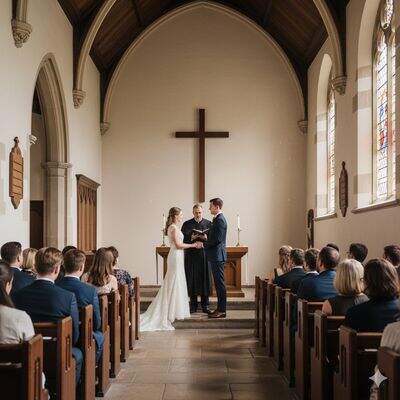
Protestant wedding ceremonies center on covenant rather than sacrament, a crucial theological distinction with practical implications. While Catholic and Orthodox traditions view marriage as a sacrament administered by the church, Protestants see it as a covenant between two people before God, with the church as witness.
This theological foundation, rooted in the Reformation principle of sola scriptura, creates remarkable flexibility in how couples celebrate their union. According to the World Council of Churches, Protestant denominations worldwide share core marriage values while expressing them through diverse cultural practices.
This difference creates remarkable freedom:
- Venue flexibility: Any location where a minister agrees to officiate
- Vow personalization: Many couples now choose to write personal vows
- Ceremony length: Typically 30-45 minutes versus 60-90 for Catholic Mass
- Remarriage allowance: Most denominations permit divorced individuals to remarry
- Interfaith accommodation: Greater flexibility for mixed-faith couples
The Protestant Denomination Spectrum
Understanding Protestant diversity helps explain why two “Protestant weddings” might look completely different:
Liturgical/High Church (Anglican, Lutheran):
- Formal processionals following ancient patterns
- Communion often included
- Traditional vestments and church settings
- Book of Common Prayer influences
Reformed/Calvinist (Presbyterian, Reformed Church):
- Covenant theology emphasis
- Moderate formality
- Strong congregational participation
- Celtic influences common
Evangelical/Low Church (Baptist, Pentecostal, Non-denominational):
- Contemporary music and relaxed structure
- Personal testimony incorporation
- Altar calls occasionally included
- Spontaneous worship elements possible
Mainline Protestant (Methodist, American Baptist, Disciples of Christ):
- Balance of traditional and contemporary
- Social justice themes
- Inclusive theology
- Flexible practices
Core Protestant Wedding Elements
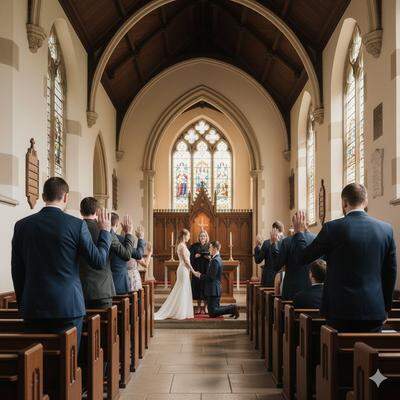
The Processional: Setting Sacred Stage
Protestant processionals establish ceremony tone while offering flexibility unknown in more liturgical traditions. The typical order:
- Grandparents/Parents seated (ushered or walking together)
- Groom enters (from side or down aisle)
- Wedding party enters (paired or separately)
- Flower girl and ring bearer
- Bride enters (with father, both parents, alone, or with groom)
Modern variations include:
- Couples entering together (growing trend among younger couples)
- Both sets of parents walking their children in
- Blended family processionals with children from previous marriages
- Pet participants (especially in outdoor ceremonies)
The Declaration of Intent: “Who Gives This Woman?”
This tradition sparks more family debates than any other element. Originally signifying property transfer, modern interpretations transform problematic history into meaningful moments:
Traditional: “Who gives this woman to be married to this man?” Modern alternatives:
- “Who presents this woman and this man to be married?”
- “Who supports this couple in their marriage?” (congregation responds)
- “Who celebrates this union with us today?” (everyone answers)
Many Protestant brides still include some version of being “given away,” but with modified language emphasizing support over transfer.
Protestant Wedding Vows: Where Tradition Meets Personality
Protestant vows showcase the tradition’s defining flexibility. Couples choose between:
Traditional Vows (from 1549 Book of Common Prayer):
“I, [name], take thee, [name], to be my wedded [husband/wife], to have and to hold from this day forward, for better for worse, for richer for poorer, in sickness and in health, to love and to cherish, till death do us part, according to God’s holy ordinance; and thereto I plight thee my troth.”
Personal Vows (increasingly popular): Personal vows have become increasingly popular, especially among younger couples. These typically include:
- How you met/fell in love (30 seconds)
- Specific promises (3-5 commitments)
- Scripture or meaningful quote
- Forever declaration
Vow Writing Tip: Keep personal vows to 1-2 minutes. Longer becomes performance rather than promise. Review with your officiant; inside jokes might not suit sanctuary settings.
The Ring Exchange: Circles of Promise
Protestant ring ceremonies maintain ancient symbolism while allowing personal touches:
Traditional blessing: “Bless, O Lord, these rings as symbols of the vows by which this man and this woman have bound themselves to each other.”
Exchange words vary by denomination:
- Anglican: “With this ring I thee wed…”
- Baptist: “This ring I give you as a token of my love…”
- Lutheran: “I give you this ring as a sign of my love and faithfulness”
- Non-denominational: Often personalized
Modern Trend: Ring warming ceremonies where guests hold and bless rings before exchange, adding community blessing to personal commitment.
The Unity Candle: Protestant Innovation
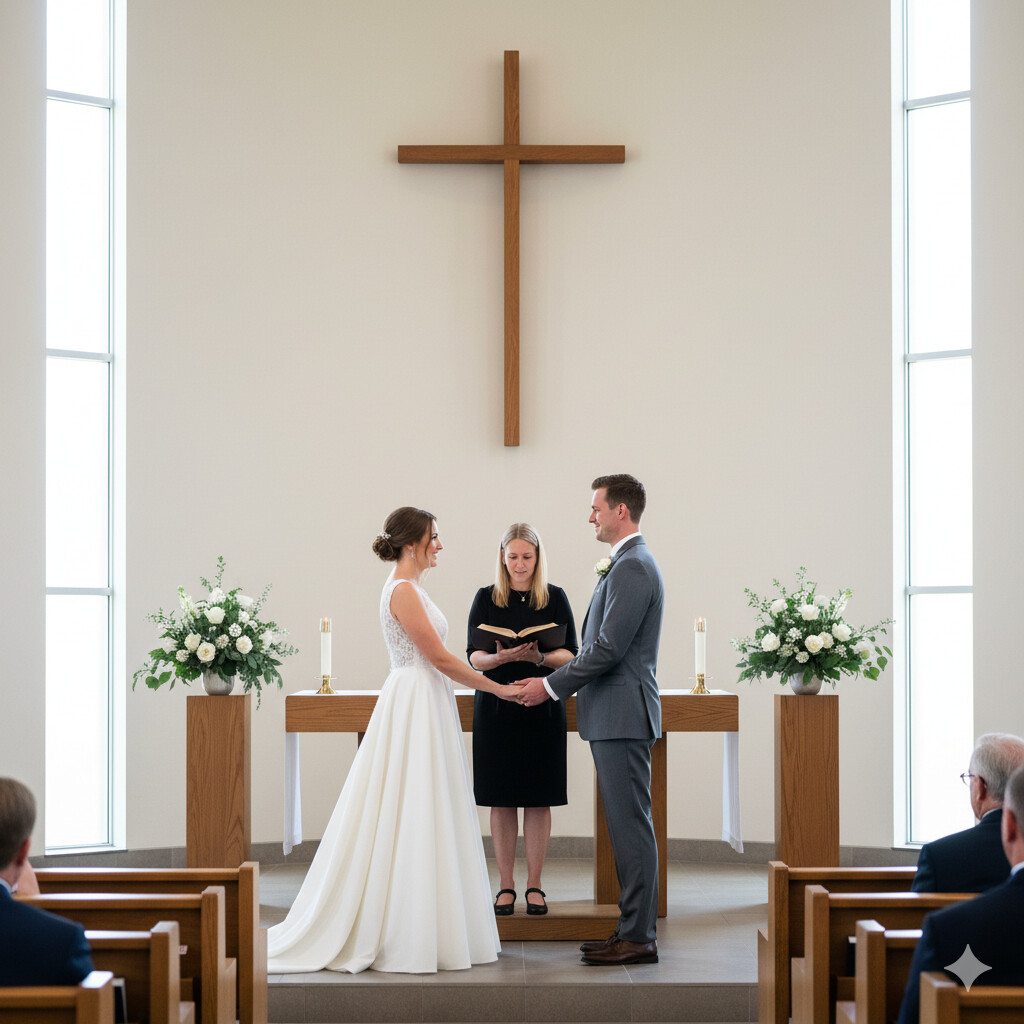
The Unity Candle ceremony appears in many Protestant weddings and represents Protestant innovation at its finest. Though its exact origins remain debated, with the ceremony gaining widespread adoption in the 1970s, it has become a beloved tradition across denominations.
How the Unity Candle Ceremony Works
- Setup: Three candles (two tapers and one pillar) placed on small table
- Mothers light tapers: During prelude or early in ceremony
- Musical interlude begins: Usually instrumental
- Couple takes lit tapers: Representing individual lives
- Together light center candle: Creating united flame
- Original candles remain lit: Preserving individual identities
Symbolic meaning:
- Two becoming one while maintaining individuality
- Families joining through union
- Light of Christ in marriage
- Visible covenant before community
Budget Range:
- Basic sets: $30-$50 USD
- Personalized/decorated: $75-$150 USD
- Heirloom quality: $200-$400 USD
Modern Unity Alternatives
When venues prohibit flames or couples seek different symbolism:
Sand Ceremony (popular for outdoor weddings):
- Different colored sands poured into single vessel
- Creates permanent art piece
- Wind-proof for beach weddings
- Cost: $30-$100 USD
Cord of Three Strands (Ecclesiastes 4:12):
- Three cords braided: bride, groom, and God
- Popular in evangelical ceremonies
- Creates lasting keepsake
- Cost: $20-$75 USD
Tree Planting:
- Couple plants sapling together
- Often includes soil from childhood homes
- Perfect for garden venues
- Cost: $50-$200 USD
Communion Together:
- First act as married couple
- Deeply meaningful for religious couples
- Requires coordination with officiant
- No additional cost
Denominational Distinctions
Lutheran Weddings: Order and Grace
Lutheran weddings (both ELCA and LCMS) reflect German theological precision with Scandinavian warmth. These ceremonies emphasize God’s grace in establishing marriage.
Distinctive elements:
- Strong liturgical structure from Lutheran Service Book
- Congregational hymn singing (not just special music)
- Often includes Holy Communion
- Emphasis on marriage as “divine estate”
- Traditional organ music predominant
Reception characteristics:
- Beer and wine common (German heritage)
- Polka dancing in Midwest congregations
- Dollar dance tradition in some regions
- Coffee and cake served separately
- Typically ends by 10-11 PM
Average costs: $15,000-$30,000 USD for 150-200 guests
Baptist Weddings: Celebrating with Intention
Baptist weddings reflect denominational diversity, from traditional Southern Baptist to progressive American Baptist approaches. The Baptist Faith and Message provides guidance while allowing local church autonomy.
Ceremony distinctions:
- Strong emphasis on personal salvation of both partners
- Scripture-heavy services
- Contemporary Christian music common
- Congregation may be asked to pledge support
- Altar calls occasionally included
Reception variations: Baptist receptions vary significantly by congregation and region:
- Traditional approach: Alcohol-free with elaborate dessert displays
- Progressive approach: Full receptions with dancing and moderate alcohol
- Common elements: Strong fellowship focus, family-friendly activities
Cultural Note: Baptist churches encompass wide practices. Always discuss specific expectations with your congregation and families rather than assuming restrictions.
Average costs: $10,000-$25,000 USD, often lower due to church venue availability and volunteer support
Methodist Weddings: Balanced Tradition
United Methodist weddings blend Wesley’s emphasis on grace with practical modern adaptation. The United Methodist Book of Worship provides framework while allowing flexibility.
Ceremony elements:
- Balance of traditional and contemporary
- Open table Communion (all invited)
- Strong social justice themes possible
- Emphasis on marriage as ministry
- Congregational participation encouraged
Reception style:
- Moderate alcohol service common
- Dancing typically included
- Mix of traditional and contemporary music
- Community fellowship emphasis
- Service project incorporation possible
Average costs: $15,000-$35,000 USD for 150-200 guests
Presbyterian Weddings: Covenant Focus
Presbyterian (PCUSA and PCA) weddings emphasize covenant theology: marriage as reflection of Christ’s relationship with the church.
Distinctive features:
- Covenant language throughout
- Celtic traditions common (handfasting, bagpipes)
- Congregation takes vows to support couple
- Reformed theology influences
- Session approval required
Reception traditions:
- Scottish/Irish heritage often celebrated
- Moderate formality
- Alcohol typically served
- Ceilidh dancing in some regions
- Academic and thoughtful speeches
Average costs: $20,000-$40,000 USD for 150-250 guests
Anglican Weddings: Protestant Formality
Anglican weddings most closely resemble Catholic ceremonies while maintaining Protestant theology. The 1979 Book of Common Prayer guides these services.
High church elements:
- Formal liturgy from Prayer Book
- Eucharist commonly included
- Traditional vestments
- Incense possible
- Chanted portions
Reception expectations:
- Formal, traditional approach
- Full bar standard
- Classical music during dinner
- Dancing after formal program
- Proper receiving line
Average costs: $30,000-$50,000 USD, highest among Protestant denominations
Protestant Wedding Attire Guide
Bridal Attire: Freedom with Reverence
Protestant brides enjoy remarkable dress freedom compared to other Christian traditions. No universal modesty requirements exist, though individual churches may have preferences.
Style flexibility:
- Silhouettes: All styles acceptable, ballgown to sheath
- Necklines: Vary by congregation comfort
- Sleeves: Optional in most Protestant churches
- Color: White traditional but not required; some choose alternative colors
- Veils: Completely optional across all denominations
Denomination tendencies (not requirements):
- Anglican/Lutheran: More traditional, often include veils
- Baptist: Modest necklines common, sleeves for ceremony
- Methodist: Middle ground, practical choices
- Non-denominational: Complete flexibility
Budget ranges:
- Budget: $500-$1,000 USD (David’s Bridal, online retailers)
- Mid-range: $1,000-$2,500 USD (boutique samples, designer sales)
- Luxury: $2,500-$10,000+ USD (designer gowns)
Modern Trend: Many Protestant brides now buy pre-owned or rent, reflecting both economic and environmental consciousness.
Groom and Wedding Party Attire
Groom’s options:
- Formal church: Tuxedo or dark suit required
- Outdoor/casual: Vest and slacks acceptable
- Summer: Lighter colors permitted
- Regional variations: Cowboy boots (Texas), seersucker (South)
Wedding party flexibility:
- Mismatched bridesmaid dresses increasingly popular
- Different styles in same color palette common
- Men’s attire often just matching ties/vests
- Children participants dressed age-appropriately
Music and Worship in Protestant Weddings
Processional and Recessional Choices
Protestant weddings enjoy unlimited musical freedom, from Bach to Bethel Music. Popular selections reflect denominational culture:
Traditional Classical (Anglican, Lutheran, some Methodist):
- Wagner’s “Bridal Chorus” (Here Comes the Bride)
- Pachelbel’s Canon in D
- Clarke’s Trumpet Voluntary
- Bach’s “Jesu, Joy of Man’s Desiring”
Contemporary Christian (Baptist, Non-denominational, Pentecostal):
- “10,000 Reasons” (Matt Redman)
- “The Blessing” (Kari Jobe/Cody Carnes)
- “Build My Life” (Housefires)
- “Goodness of God” (Bethel Music)
Hymn Arrangements (Universal appeal):
- “Great Is Thy Faithfulness”
- “Be Thou My Vision”
- “How Great Thou Art”
- “Amazing Grace”
Licensing Note: Churches need CCLI licenses for contemporary Christian music. Budget $100-$300 USD annually for proper coverage.
Music Budget Considerations
- Church organist/pianist: $200-$500 USD
- Professional soloist: $150-$400 USD
- String quartet: $800-$2,000 USD
- Full worship band: $1,500-$4,000 USD
- DJ for reception: $800-$2,000 USD
- Live band for reception: $2,500-$6,000 USD
Pre-Wedding Preparation
Protestant Premarital Counseling
While not universally mandated like Catholic Pre-Cana, most Protestant churches strongly encourage or require premarital counseling. Research consistently shows couples completing counseling report higher relationship satisfaction.
Common programs:
Prepare/Enrich (used by many clergy):
- 165-question assessment
- Identifies strength and growth areas
- Cost: $35-$80 USD per couple
- Well-researched and widely respected
Alpha Marriage Course:
- 7 sessions over dinner
- Video-based with discussion
- Often free through churches
- Focus on practical skills
Denominational programs:
- Lutheran: “Built to Last” curriculum
- Baptist: “Preparing for Marriage” by Dennis Rainey
- Methodist: “Beginnings” workshop weekends
- Presbyterian: Covenant-focused preparation
Key Topics Covered
Successful counseling addresses:
- Financial management (debt, budgets, goals)
- Communication styles and conflict resolution
- Intimacy expectations and physical relationship
- Children and parenting philosophy
- Faith practices and church involvement
- Family boundaries with in-laws
- Role expectations in marriage
Success Factor: Couples who invest time in premarital preparation tend to enter marriage with clearer expectations and better communication skills.
Protestant Wedding Reception Traditions
The Reception Framework
Protestant receptions vary more by region and denomination than any other element. However, common patterns emerge:
Typical timeline (4-5 hours):
- Cocktail hour (if applicable): 60 minutes
- Dinner service: 60-90 minutes
- Speeches and toasts: 30 minutes
- Dancing and celebration: 2-3 hours
Food and Beverage Considerations
Alcohol policies by denomination (general tendencies):
- Anglican/Lutheran/Presbyterian: Full bar common
- Methodist: Wine and beer typical
- Baptist: Varies widely by congregation
- Non-denominational: Depends on church culture
Menu trends:
- Buffet service: $40-$80 USD per guest
- Plated dinner: $60-$120 USD per guest
- Heavy appetizers: $30-$60 USD per guest
- Cake and punch: $10-$20 USD per guest
Special Protestant Reception Traditions
Anniversary Dance: All married couples dance, progressively sitting based on years married. Last couple standing (usually 50+ years) receives bouquet and shares wisdom.
Blessing Before Meal: More elaborate than simple grace, often includes thanksgiving for couple’s journey and prayer for their future.
Testimony Time: Some evangelical receptions include brief testimonies about God’s faithfulness in bringing couple together.
Worship Sets: Contemporary Protestant receptions might include 15-30 minutes of worship music with full participation.
Modern Protestant Wedding Trends
Micro Weddings and Intimate Celebrations
Recent years have seen a growing trend toward smaller, more intentional celebrations. Many Protestant couples now opt for intimate ceremonies with under 50 guests.
Benefits realized:
- Lower overall cost
- Deeper connections with each guest
- Premium venue access within budget
- Flexibility in format and timing
- Reduced planning stress
Technology Integration
Livestreaming (increasingly common):
- Basic smartphone setup: $50-$100 USD
- Multi-camera production: $500-$1,500 USD
- Professional streaming: $1,500-$3,000 USD
Digital elements:
- QR code programs and menus
- Wedding hashtags and social media walls
- Digital guest books and well-wishes
- Online RSVPs and planning tools
Sustainable Celebrations
Protestant “creation care” theology drives eco-conscious choices:
- Digital invitations (saving $500-$1,500 USD)
- Local/seasonal catering
- Potted plant centerpieces (guests take home)
- Borrowed/rented décor
- Charitable donations as favors
Your Protestant Wedding Budget Guide
Budget Breakdown: $10,000 Intimate Church Wedding (50 guests)
Ceremony: $500
- Church donation: $300
- Officiant honorarium: $200
Reception: $4,000
- Church hall rental: $300
- Catering (buffet): $2,500
- Beverages: $500
- Decorations: $400
- Cake: $300
Attire: $1,500
- Wedding dress: $800
- Groom’s suit: $400
- Accessories: $300
Photography: $2,000
- 6 hours coverage
- Digital files
- Online gallery
Music: $800
- Church musician: $300
- DJ for reception: $500
Flowers: $800
- Bridal bouquet: $200
- Bridesmaids (3): $225
- Boutonnieres: $75
- Simple arrangements: $300
Other: $1,400
- Invitations: $200
- Unity candle: $75
- Programs: $125
- Guest book: $50
- Favors: $150
- Rehearsal dinner: $600
- Miscellaneous: $200
Budget Breakdown: $25,000 Traditional Celebration (150 guests)
Venue and Catering: $15,000
- Ceremony church: $1,000
- Reception venue: $3,000
- Full catering: $10,000
- Bar service: $1,000
Photography/Video: $3,500
- Dual shooters
- 8 hours coverage
- Edited video
Entertainment: $2,000
- Ceremony music: $500
- Reception band: $1,500
Flowers/Decor: $2,500
Attire: $2,000
Invitations/Paper: $500
Transportation: $500
Miscellaneous: $1,000
Planning Timeline
12 Months Before
- Determine denomination and church
- Meet with pastor
- Set date and book venues
- Begin premarital counseling
- Create preliminary budget
9 Months Before
- Book photographer/videographer
- Hire caterer
- Book entertainment
- Choose wedding party
- Send save-the-dates
6 Months Before
- Shop for attire
- Register for gifts
- Book florist
- Plan honeymoon
- Continue counseling
3 Months Before
- Send invitations
- Finalize ceremony details
- Choose readings and music
- Plan rehearsal dinner
- Write vows (if personal)
1 Month Before
- Final fittings
- Confirm vendor details
- Get marriage license
- Finalize seating
- Create timeline
Week Before
- Rehearsal
- Deliver items to venue
- Confirm final counts
- Pack for honeymoon
- Relax and pray
Conclusion: Your Protestant Wedding, Your Way
Protestant weddings embody the Reformation principle of individual faith expression within community tradition. Whether you light a Unity Candle in a Lutheran cathedral or exchange personally written vows in a backyard Baptist ceremony, your wedding reflects both timeless Christian values and contemporary personal meaning.
The freedom inherent in Protestant tradition isn’t absence of structure; it’s the gift of choice. You can honor grandmother’s hymn preferences while including contemporary worship. You can wear your mother’s dress or design something entirely new. You can serve communion to unite families or plant a tree to symbolize growth.
This flexibility extends beyond ceremony into celebration. Your reception might feature elaborate Swedish traditions at a Lutheran gathering, alcohol-free dessert extravaganzas at Baptist celebrations, or contemplative worship at evangelical ceremonies. Each choice creates meaning specific to your faith journey.
Your Next Steps:
- Choose your church/venue (popular dates book 12+ months ahead)
- Discuss expectations with families and officiant
- Start premarital counseling (even if not required)
- Set your budget based on priorities
- Remember the purpose: Two becoming one before God and community
Protestant weddings work because they acknowledge that sacred moments don’t require identical scripts. In the freedom to choose your traditions lies the opportunity to create ceremonies as unique as your love story, as meaningful as your faith journey, and as lasting as the covenant you make.
After all, the Protestant Reformation began with challenging tradition, and your wedding continues that legacy by creating new traditions that honor both heritage and hope.
For denomination-specific guides, explore our complete collection of Christian wedding traditions.
Frequently Asked Questions
1. Can we write our own vows in a Protestant wedding?
Absolutely! This is actually one of the beautiful freedoms of Protestant ceremonies. About 73% of Protestant couples under 35 now write personal vows, and most denominations encourage it. The key is keeping them to 1-2 minutes each, any longer and it becomes more performance than promise.
Pro tip: Write them separately but have your officiant review both to ensure they're roughly the same length and tone. Nothing's more awkward than one person delivering Shakespeare while the other manages three sentences.
2. Do Protestant weddings require premarital counseling?
While not universally mandated like Catholic Pre-Cana, about 80% of Protestant churches strongly encourage or require it. Here's the thing though, couples who complete counseling show 30% higher success rates, so even if your church doesn't require it, do it anyway. Most programs run 6-8 sessions and cost between $35-$80 USD total. Think of it as the best investment in your marriage you'll ever make.
3. What's the deal with the Unity Candle ceremony?
The Unity Candle is actually a Protestant innovation from the 1970s, younger than your parents but somehow feels ancient and sacred. About 75% of Protestant couples include it. You light individual candles (representing your separate lives), then together light a center candle while keeping your individual flames burning. It's beautiful symbolism for two becoming one while maintaining individual identities. Budget $30-$150 USD for a nice set, or go heirloom quality for $200-$400 USD.
4. Can we have our Protestant wedding outside of a church?
This is where Protestant flexibility really shines! Unlike Catholic or Orthodox traditions, most Protestant denominations allow ceremonies anywhere your minister agrees to officiate. Gardens, beaches, barns, your backyard, all fair game. Baptist and more conservative churches might prefer traditional venues, while non-denominational congregations embrace anywhere meaningful to you. Just confirm with your specific minister first.
5. How long is a typical Protestant wedding ceremony?
Most Protestant ceremonies run 30-45 minutes, compared to 60-90 minutes for a Catholic Mass. The sweet spot seems to be around 35 minutes, long enough to feel substantial, short enough that your nephew doesn't start a meltdown. Episcopal services with communion might stretch to an hour, while a simple Baptist ceremony could wrap in 25 minutes.
6. Is alcohol allowed at Protestant wedding receptions?
The answer varies wildly by denomination and even individual congregation. Episcopal, Lutheran, and Presbyterian receptions commonly feature full bars. Methodists often serve wine and beer. Baptist practices range from completely dry to fully stocked, depending on the specific church. Your best bet? Have an honest conversation with your officiant and families early in planning. There's usually a compromise that works for everyone.
7. Do both partners need to be Protestant for a Protestant wedding?
Most Protestant churches welcome interfaith marriages, though policies vary. Generally, they require at least one partner to be Christian, and some request that the non-Protestant partner attends premarital counseling. Episcopal and Methodist churches tend to be most flexible, while some Baptist or evangelical churches might have stricter requirements. The key is transparency with your officiant from the start.
8. What's the typical cost of a Protestant wedding?
Protestant weddings actually span the entire budget spectrum. A simple Baptist church wedding with cake and punch reception might run $5,000-$10,000 USD. A formal Episcopal celebration averages $30,000-$50,000 USD. The denomination average sits around $15,000-$30,000 USD for 150 guests. The beautiful thing? Protestant flexibility means you can create meaningful celebrations at any budget level.
9. Can divorced individuals get married in Protestant churches?
Yes, this is one of the key differences from Catholic tradition. Most Protestant denominations permit remarriage after divorce, viewing it through the lens of grace and redemption. Some churches might require a conversation about the previous marriage or a waiting period, but outright prohibition is rare. Specific policies vary by denomination and even individual churches, so discuss your situation openly with your pastor.
10. What music can we use in a Protestant wedding?
The sky's the limit! Protestant weddings enjoy complete musical freedom, from Bach to Bethel Music, Pachelbel(PAH-khel-bell) to contemporary praise. Traditional churches might prefer classical or hymns, while contemporary congregations embrace modern Christian music. You can even include secular music meaningful to your relationship, though some churches prefer keeping the ceremony music sacred. Just remember: churches need CCLI licenses for contemporary Christian music, which might add $100-$300 USD to your budget.
11. Do Protestant weddings include communion?
It depends on your denomination and preference. Episcopal and Lutheran ceremonies often include Eucharist(YOO-kuh-rist), while Baptist and non-denominational services typically don't. Some couples choose communion as their first act as a married couple, deeply meaningful and no extra cost. If you're including it, add about 10-15 minutes to your ceremony time.
12. What's appropriate wedding attire for a Protestant ceremony?
Protestant brides enjoy remarkable freedom, no universal modesty requirements exist. All dress styles work, from ballgowns to sheaths, though individual churches might have preferences. About 15% now choose non-white dresses. Grooms typically wear suits or tuxedos for formal churches, but outdoor ceremonies might see everything from khakis to cowboy boots. The golden rule? When in doubt, ask your venue.
13. Can we include non-religious readings in our ceremony?
Many Protestant ceremonies incorporate secular readings alongside scripture, poetry, literature, even song lyrics (though not reproduced in full). The key is balance and relevance. Most officiants are fine with one or two non-religious readings if they speak to love, commitment, or marriage. Shakespeare's sonnets, Rumi's poetry, or even excerpts from favorite novels often make appearances.
14. Who can officiate a Protestant wedding?
Requirements vary by state and denomination. Generally, any ordained Protestant minister can officiate. Some denominations also recognize lay ministers or church elders. Many states allow friends or family to get ordained online through organizations like Universal Life Church, though some denominations don't recognize these ceremonies as religiously valid. Always verify both legal and church requirements.
15. What's the Protestant stance on "giving away" the bride?
This tradition gets more family debate than any other element! Originally about property transfer, modern Protestant weddings transform it into support and blessing. Popular alternatives include "Who presents this couple?" or "Who celebrates with us today?" About 68% of Protestant brides still include some version, but with updated language. Some couples have both sets of parents walk them in, or enter together as equals.