Sikh Wedding Traditions: A Complete Guide to Anand Karaj Ceremonies
When Your Wedding Starts at 4 AM (And Everyone's Actually Happy About It)
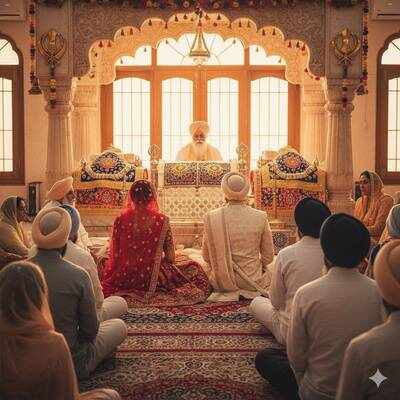
Stars still pierce the purple sky when the bride’s aunties arrive, armed with vatna (turmeric paste) and songs that would make sailors blush. This is maiyan (cleansing ceremony), strategically timed for Amrit Vela, those mystical pre-dawn hours when Sikhs believe the veil between earth and divine grows thinnest. Each stroke of turmeric carries a blessing, each folk song tells a story of marriages that survived everything from partition to immigration.
Pro Tip: The 4 AM start isn’t negotiable, but the aunties WILL have chai and samosas ready. Your resistance crumbles with the first bite of their secret-recipe chutneys.
Meanwhile, across town, the groom’s morning unfolds differently. His sisters perform their sacred duty: tying kalire (golden ornaments) to his turban while simultaneously planning the evening’s emotional ambush: stories about his childhood that will surface during the reception speeches. His friends, supposedly there for support, are actually choreographing bhangra (folk dance) moves that violate several laws of physics.
By sunrise, the energy shifts from intimate to explosive. The baraat (wedding procession) preparations resemble a military operation crossed with a music festival. Punjabi uncles adjust their turbans for optimal dancing. The dhol (drums) players, who seemingly teleported from another dimension, begin their warm-up that rattles windows three blocks away.
Musical Note: Dhol players possess supernatural timing, knowing exactly when your elderly aunt will attempt her signature move from 1973. The bride’s cousins, meanwhile, execute reconnaissance for the day’s most lucrative tradition: joota chupai (shoe hiding). These aren’t children playing games; they’re trained negotiators who’ve studied YouTube videos of past ransoms and adjusted for inflation.
Real Wedding Story: “My husband’s shoes ended up in three different Birmingham locations, including one in my aunt’s freezer between the frozen samosas and ice cream. My 12-year-old cousin walked away significantly richer and immediately bought PlayStation games. Three years later, she still sends him thank you cards signed ‘Your Favorite Shoe Thief.’” (Harpreet, married in 2023)
Understanding Sikh Wedding Costs: Community Over Commerce
The mathematics of Sikh weddings defies logic. The Anand Karaj ceremony itself? Free. The gurdwara? No charge. The Guru Granth Sahib (holy book)? Priceless, yet costs nothing to use. The granthi (priest) who conducts the ceremony? Accepts only voluntary offerings. Yet somehow, families create celebrations that become the benchmark against which all future family weddings are measured.
The secret lies in seva (selfless service), an economic model that would baffle MBA students. Watch closely: Aunty Paramjeet commands the tea station with military precision. Your cousin Jaspreet has been chopping onions since yesterday, tears streaming not from emotion but from kilos of onions. Those uncles directing parking with inexplicable authority? They appointed themselves and nobody questions it.
Cost Comparison: Traditional venues charge significant fees for empty space and the right to bring your own everything. Gurdwaras charge nothing but expect you to feed everyone (including that family who definitely came for the wrong wedding but stayed for the right food).
What actually costs money reveals Punjabi priorities perfectly. Flowers (the gurdwara must resemble paradise), dhol players (non-negotiable for proper bhangra), and gold jewelry (some questions are better left unasked). The unspoken competition drives these expenses: whose marigold arrangements achieved maximum aunty gasps? Whose bhangra team moved in tighter synchronization? Whose langar made people forget their diets?
Money Matters: That alcohol budget you saved (it’s forbidden anyway)? Redirect it to hiring dhol players who can make 70-year-old uncles dance like they’re 17 again.
That Sacred Moment When a Scarf Changes Everything
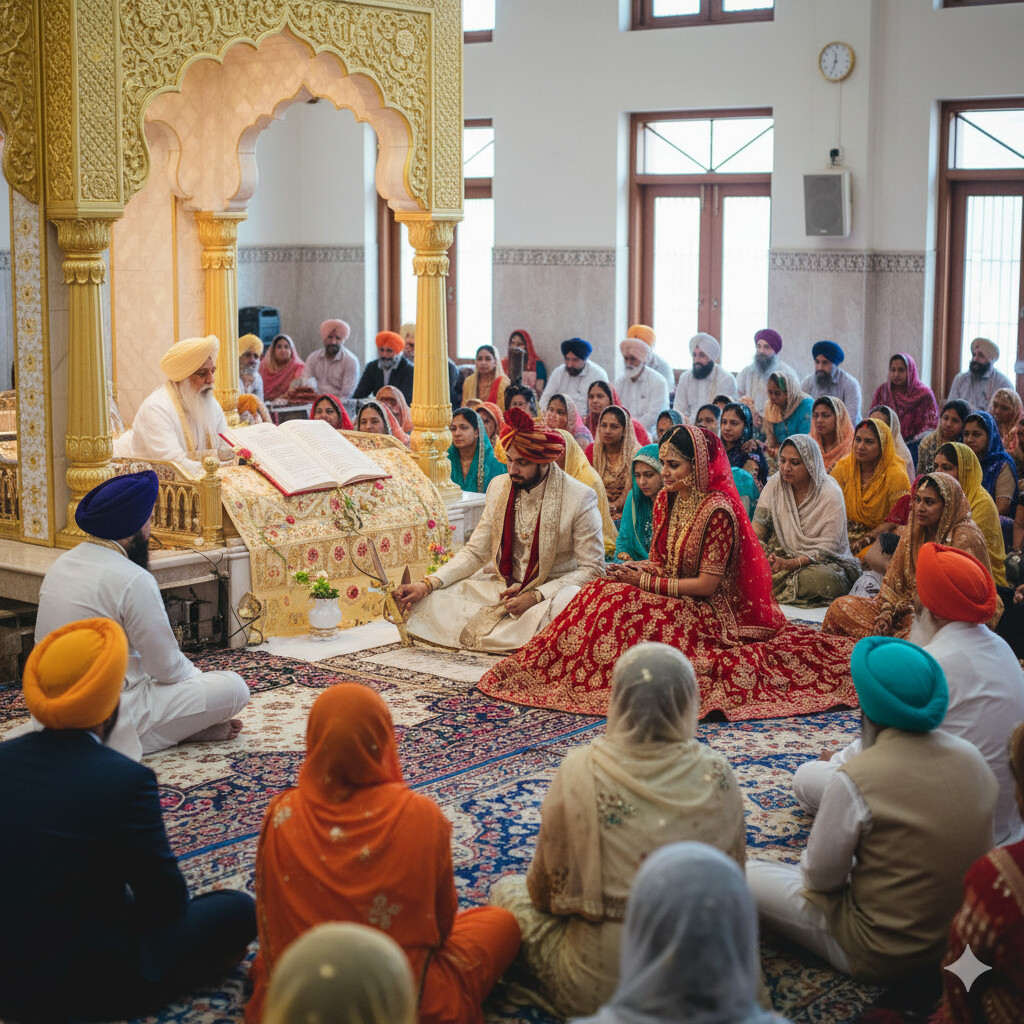
As the bride enters the darbar sahib (main prayer hall), a hush falls that could quiet monsoons. She walks first, revolutionary in South Asian culture, draped in red silk and traditional gold jewelry. The groom follows, still dizzy from the milni (family introduction ceremony) where his father and her father hugged competitively enough to require chiropractor visits.
The Vibe: Centuries of muscle memory guide every movement, yet each wedding feels like the first time anyone’s witnessed love transform into sacred union.
The four laavan (marriage hymns) aren’t just songs; they’re a roadmap for spiritual evolution. First laav: duty and righteousness. Second: growing in love. Third: detaching from ego (the bride leads, reminding everyone that Sikhism pioneered gender equality centuries ago). Fourth: complete spiritual merger, two bodies realizing they house one soul.
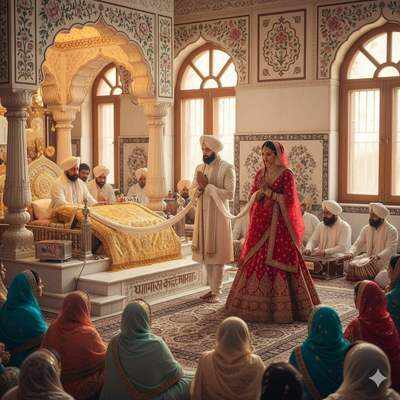
During each circuit around the Guru Granth Sahib, the couple remains connected by the palla (groom’s scarf). Watch the moment when the bride’s father places that scarf in his daughter’s hands; it’s not giving her away but literally tying her to her future. The congregation showers flower petals that somehow always land in the groom’s beard, nature’s way of decorating him for photos.
Quick Warning: The fourth laav’s completion means marriage accomplished: no announcement, no kiss, just done. Blink and you’re photographing married people.
Between laavan, the raagis (musicians) perform kirtan that transcends language barriers. Their harmoniums and tablas create frequencies that trigger spontaneous crying in people who claimed they “don’t do emotions.” When the congregation rises for ardas (prayer), moving as one spiritual organism, even atheists feel something shift in their chest.
Pro Tip: Those tissue boxes scattered strategically throughout the gurdwara? They’re not decorative. When the iron-willed grandmother who survived partition starts crying during the third laav, you’ll need several boxes minimum.
The ceremony’s climax arrives quietly: the couple receives their new shared spiritual name, marking their metamorphosis from parallel lines to an infinite circle.
Why Hundreds of Strangers Will Show Up (And You'll Actually Love It)
Sikh wedding mathematics operates in mysterious ways: invite a moderate number, expect more, feed everyone who arrives. This isn’t poor planning; it’s radical hospitality encoded in spiritual DNA. Langar doesn’t discriminate. That man in the corner might be the bride’s boss’s neighbor’s uncle. Or he might have wandered in for morning prayers and discovered a feast. Either way, he’s family now.
Celebration Tip: The stranger sitting beside you might become your best friend by dessert. Sikh weddings create instant communities.
The reception transforms into five simultaneous film sets. Corner one: teenage cousins performing choreography they’ve practiced since the engagement, mixing classical kathak with TikTok trends. Corner two: aunties engaged in giddha (women’s folk dance), moving with energy that defies both age and physics. Corner three: the uncles’ bhangra circle, where aging knees suddenly remember their youth.
Guest Count Reality: Every invitation spawns shadow guests through cousin networks, WhatsApp groups, and the universal Punjabi phone tree that alerts everyone within six degrees of separation.
The sangeet (musical celebration) the night before operates as Broadway meets rap battle meets your living room at 2 AM during Diwali. Families compete through song and dance, armed with cardboard cutouts of the couple’s most embarrassing photos and costume changes that would exhaust Lady Gaga. Points are awarded for making the other side laugh, cry, or surrender from exhaustion.
Cost Comparison: Professional DJs charge substantial fees. Punjabi families bring Harjot’s speaker system, Simran’s Spotify premium, and natural talent that emerges after two plates of samosas (total cost: negligible plus snacks).
The Great Shoe Heist: A Beloved Tradition
No tradition captures Sikh wedding genius quite like joota chupai: institutionalized theft with negotiated ransoms. This isn’t casual mischief; it’s organized activity that would impress heist movie directors. The bride’s sisters and cousins form syndicates with designated roles: lookouts, distraction specialists, negotiators, and hiding experts who think in three dimensions.
Budget Alert: Smart grooms budget for shoe ransom. Genius grooms wear decoys while friends guard the real ones.
The theft occurs during the ceremony when the groom must remove his shoes. Within seconds, they vanish into a network of hiding spots that span multiple buildings. Post-ceremony negotiations resemble international peace talks. The groom’s brothers mediate while the bride watches, entertained by her husband’s first official financial crisis.
Standard ransoms start modestly for “basic return service” but escalate based on the sisters’ reading of weakness. Tears? Add more. Checking your phone for the bank balance? Add more. Some modern couples have introduced creative payment methods: one memorable wedding featured cryptocurrency transfer.
Survival Tip: Grooms, assign your most paranoid friend as shoe security. Brides, your 8-year-old niece possesses ruthlessness your older sisters lack, so deploy accordingly.
The tradition serves deeper purposes: forcing families to interact playfully, giving children official roles, and yes, funding the next generation’s shopping sprees (extensively documented on Instagram with captions like “Thanks jiju!”).
When Food Becomes a Spiritual Experience (And There's Always Seconds)
Langar transcends catering; it’s meditation through mastication, seva through sustenance. The menu hasn’t changed in centuries because perfection needs no revision: dal (lentils) that comfort souls, sabzi (vegetables) that convert carnivores, roti (bread) that arrives hot despite physics suggesting otherwise, and kheer (rice pudding) that tastes like edible moonlight.
Fun Fact: The gurdwara’s karah prasad (sacred pudding), equal parts wheat flour, sugar, and ghee, defies recreation. Home versions never taste right, suggesting divine seasoning exists.
Everyone sits on the floor in pangat (rows), eliminating hierarchy. CEOs beside students, doctors beside drivers, all equal before dal. Volunteers serve with military precision, their sixth sense detecting empty plates through crowds. The aunty with the roti basket possesses supernatural abilities: she knows you’re full before you do and she will win that battle.
Pro Tip: Don’t fight the third helping. Resistance creates scenes. Acceptance brings peace. Your stretchy pants were prophetic.
The reception feast operates on competitive feeding principles. Multiple dishes, including paneer preparations that convert vegans, chole bhature that redefines chickpea possibilities, and enough sweet varieties to satisfy any palate. The open kitchen policy means wandering into prep areas yields secret tastings and recipes that aunties swear they’ll share but never do.
Real Wedding Story: “We ordered for a moderate crowd. More showed. Everyone ate twice, and we still had leftovers. Sikh weddings violate conservation of mass but nobody questions it.” (Gurpreet, wedding caterer)
The Dress Code That Launched a Thousand Shopping Trips
Sikh wedding fashion follows one rule: more is more, then add jewelry, then add more jewelry. The bride’s lehenga (ornate skirt and blouse) represents significant investment, weighing enough to qualify as resistance training. Each thread tells stories, embroidered by artisans who spent months creating wearable art. The chooda (wedding bangles), always red and white, must survive months of wear while triggering unsolicited marriage advice from every aunty within visual range.
Money Matters: Rental lehengas photograph identically to purchased ones. Save here, splurge on jewelry that becomes family heirlooms, pieces your granddaughter will wear while rolling her eyes at “vintage” styles.
The groom’s sherwani (formal outfit) represents careful investment, but the real focus is his pagri (turban), specially tied by someone who treats fabric like origami and takes payment in blessings plus cash. The kalgi (ornament) adorning his turban might be a significant piece; some families pass down antique pieces worth considerable sums, creating insurance nightmares but beautiful photos.
The Vibe: If you can still move comfortably, you’re underdressed. If your outfit doesn’t require strategic bathroom planning, you’ve failed at wedding fashion.
Guest fashion becomes competitive sport. Aunties coordinate colors within friend groups, creating rainbow sections in photos that look accidentally intentional. The unspoken rule: never outshine the bride, but definitely outshine other guests. This creates arms races where simple ceremonies become fashion weeks, with outfit changes between events that would exhaust supermodels.
Pro Tip: Pack backup safety pins, fashion tape, and designate someone as emergency sari draper. Wardrobe malfunctions during bhangra aren’t probable; they’re guaranteed.
Those Pre-Wedding Rituals That Turn Families Into Event Planners
The path to Anand Karaj begins months earlier with kurmai (formal engagement), where families exchange shagun (auspicious gifts) and enough dried fruits to survive nuclear winter. The thaka (formal agreement) celebrates with mithai (sweets) distribution that reaches extended family, coworkers, neighbors, and that person who delivers Amazon packages.
Critical Warning: Once you book the gurdwara date, it CANNOT change. Check your calendar, Mercury retrograde, cricket schedules, and your cousin’s board exams before committing.
Two weeks before the wedding, daily events begin their beautiful assault on productivity. The jago (wake ceremony) involves parading through neighborhoods with a decorated pot, singing songs that announce the wedding while revealing embarrassing childhood stories. Modern jagos feature matching t-shirts saying things like “Jassi’s Wedding Squad,” choreographed routines, and portable speakers that definitely violate noise ordinances.
Time Management: Every pre-wedding event runs on IST (Indian Stretchable Time). “Mehndi at 3 PM” means arrival at 4:30, start at 6, end at 2 AM. Plan accordingly.
The kangna (thread ceremony) requires specific threads tied to wrists that must survive until the wedding, despite showering, clothes changing, and life happening. The vatna ceremonies involve turmeric paste application while relatives sing songs that somehow always mention that time you cried at school. Each ritual demands specific outfits, meaning families essentially plan ten different events with corresponding shopping trips that single-handedly support local clothing economies.
Why the Four Sacred Circles Mean More Than Any Vows
The laavan aren’t just words; they’re GPS coordinates for a spiritual journey. First laav: establishing duty to family and righteousness. Second: recognizing the divine in your partner. Third: detaching from ego to merge with something greater. Fourth: achieving complete spiritual union where two become one while remaining two.
Musical Note: Each laav lasts approximately 4-5 minutes. Time bathroom breaks for the pauses between rounds or risk missing pivotal moments.
Every Sikh couple for centuries has walked these identical circles, heard these same words, made these eternal commitments. Your grandparents walked these steps. Their grandparents walked these steps. There’s profound power in knowing you’re not writing new vows but joining an unbroken chain of unions that survived everything history threw at them.
Professional Support: Some gurdwaras offer pre-wedding counseling explaining the laavan’s meaning. Take it. Understanding transforms ritual from performance to promise.
The physical act of walking together, connected by cloth, witnessed by hundreds, creates vulnerability that strips pretense. By the fourth circle, even the most composed couples show emotion. When the bride’s father places the palla in her hands, transferring responsibility from parent to partner, generations of love crystallize in one gesture that consistently triggers what Punjabis call “the crying that cleanses souls.”
The Morning-After Traditions Nobody Warns You About
The wedding doesn’t end at the reception. The doli (bride’s departure) arrives like emotional ambush: suddenly she’s actually leaving her parents’ home. Modern couples who’ve lived together for years still find themselves sobbing as the bride throws rice over her shoulder, symbolically repaying parents for raising her. Cars decorated with more flowers than a botanical garden follow the couple to the groom’s house, honking in patterns that announce “NEW BRIDE INCOMING” to the entire neighborhood.
Pro Tip: Waterproof mascara isn’t optional for doli. The bride’s brothers will cry carrying her to the car. The tough uncle will cry. The family dog will look depressed. Everyone cries.
At the groom’s house, games determine future marital dynamics. Finding rings in milk bowls: whoever wins supposedly dominates the marriage. The couple competes in increasingly ridiculous challenges while relatives place bets and offer commentary that would make sports broadcasters jealous. These games serve a purpose: breaking ice between the bride and her new family through laughter rather than formal introduction.
Critical Warning: The bride must kick a vessel of rice upon entering for prosperity. Missing requires starting over. Pressure level: Olympic penalty kick with your mother-in-law watching.
The reception at the groom’s house, happening immediately or weeks later depending on everyone’s recovery time, feels different. The bride’s family arrives as honored guests experiencing reverse hospitality. It’s the wedding sequel where everyone’s more relaxed, speeches get genuinely funny, and uncles’ dance moves become increasingly adventurous because they know the photographers left.
Modern Twists That Would Make the Gurus Smile
Today’s couples blend tradition with innovation in ways that honor both. Destination Anand Karajs happen at historic gurdwaras worldwide, from the Golden Temple in Amritsar to local gurdwaras in Toronto, Birmingham, or Silicon Valley. Live-streaming brings global participation, with relatives in Punjab watching New York ceremonies while providing real-time commentary via WhatsApp groups that never sleep.
Some couples create wedding hashtags that trend locally (#JassiGotJazzy), hiring photographers who specialize in “candid” shots requiring 40 minutes of preparation to look spontaneous. The traditional horse might become a vintage Rolls Royce, though at least one uncle will insist the ghodi brings better luck, and he’s usually right.
Real Wedding Story: “We had QR codes for digital shagun, a Twitter wall for guest messages, and my nanaji still blessed every physical rupee note. Some traditions don’t need disrupting.” (Simran, tech wedding 2024)
Environmental consciousness has introduced biodegradable everything, digital invitations that confuse aunties (“But how do I put it on my fridge?”), and locally-sourced langar ingredients that would impress farm-to-table restaurants. Yet the core remains unchanged: the four walks, the shared cloth, the community feast, the radical equality that makes Sikh weddings revolutionary acts disguised as celebrations.
Connections to Other Wedding Traditions
Sikh weddings share beautiful connections with other religious and cultural traditions, particularly those from the Indian subcontinent:
- Hindu Wedding Traditions: Many pre-wedding rituals like mehndi and sangeet are shared between Sikh and Hindu celebrations, though the religious ceremonies differ significantly
- Indian Wedding Traditions: Explore the broader cultural context of weddings across India, where Sikhism originated and continues to thrive
- Pakistani Wedding Traditions: Punjab spans both nations, and Sikh communities in Pakistan maintain these sacred traditions
- Islamic Wedding Traditions: Understanding interfaith dynamics in South Asia, where Sikh and Muslim communities have coexisted for centuries
- Buddhist Wedding Traditions: Another Dharmic tradition with emphasis on spiritual union over legal contract
Frequently Asked Questions
What should non-Sikh guests know before attending?
Cover your head in the gurdwara (scarves provided at the entrance), remove shoes before entering, and prepare to sit on the floor. Don’t panic about protocol; Sikhs are incredibly welcoming and someone will quietly guide you. Skip the pre-gaming (you’ll be the only intoxicated person in a very sober room), and bring an appetite that can handle multiple meals disguised as one event. The head covering isn’t about modesty; it’s about respect for the sacred space housing the Guru Granth Sahib.
Can weddings happen any day of the week?
Technically yes, but Sikh families consult more factors than NASA launching shuttles. Astrological charts, family schedules, cricket tournaments, board exams, and Mercury retrograde all factor in. Sundays dominate because of work schedules, though traditional families prefer astrologically auspicious dates. Some gurdwaras only perform Anand Karaj in mornings (before noon is traditional), so afternoon ceremonies may not follow traditional protocol, though you’d never know from how many people ask for them.
What’s the deal with no alcohol at Sikh weddings?
Alcohol is strictly forbidden in Sikhism, making these possibly the only South Asian celebrations where uncles dance harder sober than drunk. This doesn’t diminish the party; if anything, it intensifies it. The energy comes from dhol beats, competitive bhangra, and natural Punjabi enthusiasm that doesn’t need chemical enhancement. Some modern couples host separate cocktail events at hotels, but the main ceremonies remain dry. The result? No sloppy speeches, no regrettable dance moves, and everyone remembers everything, blessing or curse depending on your perspective.
How much money should you give as a gift?
Shagun must be odd numbers ending in 1 (such as 101, 501, or 1,001 in your local currency) because odd numbers are auspicious and the extra unit symbolizes continuity. The appropriate amount depends on your relationship to the couple and local customs. Cash goes in decorated envelopes with your name clearly written (aunties maintain secret ledgers for reciprocal giving at future weddings). Some modern couples request charitable donations instead, though aunties still slip cash envelopes because “tradition is tradition, beta.”
Why do some ceremonies happen at 3 AM?
Amrit Vela (ambrosial hours) between 3-6 AM holds special spiritual significance; it’s when the veil between physical and divine grows thinnest. The jaggo traditionally happened at night to announce weddings when people were home from fields. The maiyan before dawn ensures the bride glows with divine blessing rather than just turmeric. Modern families might adjust timings slightly, but someone’s grandmother will definitely mention how “in my day, we started at 2 AM and were grateful.”
What happens if someone objects during the ceremony?
Unlike Hollywood weddings, there’s no “speak now or forever hold your peace” moment. The marriage was approved by both families and the gurdwara committee long ago. If someone has objections, they missed their window during the months of preparation. Once the laavan begin, the ceremony becomes a matter between the couple and the Guru; human objections become irrelevant. That said, one aunty will always whisper about how the bride could have done better, but that’s just ambient Punjabi commentary that comes standard with every wedding.
Can divorced individuals have an Anand Karaj?
Yes, Sikhism allows remarriage for widowed or divorced individuals without stigma. The ceremony remains identical: no special rituals, no reduced celebrations. The religion emphasizes moving forward rather than remaining alone. While younger Sikhs fully support this, some elders might gossip (though they’ll still attend and eat everything). Second weddings often scale down pre-events but maintain the full Anand Karaj ceremony because spiritual union doesn’t diminish with repetition; if anything, it deepens with wisdom.
What’s the most important tradition that couples shouldn’t skip?
Beyond the mandatory Anand Karaj, couples consistently say the milni (family introduction ceremony) creates bonds that last lifetimes. This ritual where corresponding family members embrace seems simple but establishes relationships extending beyond the couple. The seemingly silly post-wedding games matter too; they break formality and create inside jokes that surface at family gatherings decades later. But if you skip the karah prasad distribution, prepare for spiritual consequences and aunty judgment that follows you into the afterlife and possibly the next one too.
Frequently Asked Questions
What is an Anand Karaj ceremony?
Anand Karaj, meaning 'ceremony of blissful union,' is the Sikh wedding ceremony conducted in a gurdwara (Sikh temple). The ceremony centers around four laavan (sacred hymns) during which the couple circles the Guru Granth Sahib (holy book) four times while connected by a palla (scarf). Unlike Western weddings, there are no vows exchanged or pronouncements - the couple is married after completing the fourth circle.
How long does a Sikh wedding ceremony last?
The Anand Karaj ceremony itself typically lasts 60-90 minutes. However, the complete wedding celebrations span 3-5 days, including pre-wedding events like sangeet, mehndi, jago, and maiyan ceremonies. The wedding day starts as early as 4 AM with preparations and continues with the baraat, ceremony, langar, and reception, often lasting until midnight.
Can non-Sikhs attend an Anand Karaj ceremony?
Yes, absolutely! Gurdwaras welcome people of all faiths, backgrounds, and cultures. Non-Sikh guests should cover their heads (scarves are provided), remove shoes at the entrance, and sit on the floor during the ceremony. The inclusive nature of Sikhism means everyone is welcome to witness the ceremony and partake in langar (community meal) afterward.
What should I wear to a Sikh wedding?
Dress modestly and colorfully. Women typically wear salwar kameez, lehenga, or sarees with a dupatta for head covering. Men wear kurta pajama or formal suits with a handkerchief for head covering in the gurdwara. Avoid black (considered inauspicious) and white (associated with mourning). The general rule is: if you can move comfortably, you're underdressed. Bright colors and heavy embellishment are encouraged.
Why is alcohol not served at Sikh weddings?
Alcohol is strictly forbidden in Sikhism as it clouds judgment and distances one from spiritual consciousness. Sikh weddings prove that incredible celebrations don't need alcohol - the energy comes from dhol beats, bhangra dancing, and natural Punjabi enthusiasm. Some modern couples might host separate cocktail events at hotels, but all religious ceremonies and gurdwara events remain completely dry.
What is the significance of the four laavan?
The four laavan (wedding hymns) represent stages of spiritual growth and marital union. The first describes duty to family and community, the second speaks of growing love, the third details detachment from ego (bride leads this round), and the fourth describes complete spiritual merger. These hymns, composed by Guru Ram Das, have been used unchanged for 500 years, connecting every Sikh couple to their ancestors.
How much money should I give as a wedding gift?
Sikh wedding gifts (shagun) must be odd numbers ending in 1 for auspiciousness (₹101, ₹501, ₹1,001, etc.). Acquaintances typically give ₹501-₹1,100, friends give ₹1,100-₹5,000, close friends ₹5,000-₹11,000, and family members ₹21,000+. Cash goes in decorated envelopes with your name clearly written. The extra rupee symbolizes the continuity of the relationship.
What is joota chupai?
Joota chupai is the playful tradition where the bride's sisters and cousins steal and hide the groom's shoes during the ceremony. After the ceremony, negotiations begin for the shoes' return, with ransoms typically ranging from ₹10,000-₹50,000. This tradition creates fun interaction between families and gives younger family members an official role. Smart grooms wear decoy shoes and hide the real ones with trusted allies.
What is langar and who can eat it?
Langar is the free community meal served at all Sikh events, embodying principles of equality and service. Everyone - regardless of religion, caste, or economic status - sits together on the floor and eats the same vegetarian meal. At weddings, this includes guests, strangers, and anyone who enters the gurdwara. The meal typically includes dal, sabzi, roti, rice, and kheer, all prepared by volunteers as seva (selfless service).
Can Sikh weddings happen in the afternoon or evening?
Traditional Anand Karaj ceremonies should occur before noon, ideally during Amrit Vela (pre-dawn hours) when spiritual energy is considered strongest. Most gurdwaras only perform ceremonies in the morning. This timing is based on religious tradition, not convenience. Evening celebrations like receptions can happen, but the actual Anand Karaj ceremony follows strict morning timing.
What happens during the milni ceremony?
Milni is the formal introduction ceremony where corresponding family members from both sides meet and embrace. Fathers meet fathers, mothers meet mothers, uncles meet uncles, often exchanging garlands and gifts. This sometimes becomes competitive with family members trying to lift each other off the ground during hugs. The ceremony establishes relationships between families that extend beyond just the couple.
Do Sikh brides wear red?
Traditionally yes, but not mandatory. Red symbolizes prosperity and fertility in Punjabi culture. Many brides wear red lehengas or salwar kameez, though modern brides might choose pink, maroon, orange, or other vibrant colors. The chooda (wedding bangles) are always red and white. The key requirement is modest dress that covers the head during religious ceremonies.
What is the significance of the palla ceremony?
The palla is the groom's scarf that physically connects the couple during the laavan. The bride's father places one end in her hands, symbolizing the transfer of responsibility from parent to spouse. This isn't 'giving away' the bride but literally binding the couple together for their spiritual journey. The scarf remains connected throughout all four circles around the Guru Granth Sahib.
Can divorced individuals have an Anand Karaj?
Yes, Sikhism allows remarriage for divorced or widowed individuals. The ceremony remains identical with no special rituals or restrictions. The religion emphasizes moving forward in life rather than remaining alone. While some older community members might have opinions, the gurdwara and religious doctrine fully support remarriage with the complete Anand Karaj ceremony.
What pre-wedding rituals are essential in Sikh weddings?
Key pre-wedding rituals include kurmai (engagement), sangeet (musical night), mehndi (henna ceremony), jago (announcement procession), and maiyan/vatna (turmeric ceremonies). While the Anand Karaj is the only religiously required ceremony, these cultural traditions build excitement, bring families together, and create lasting memories. Each family decides which traditions to include based on their preferences and regional customs.